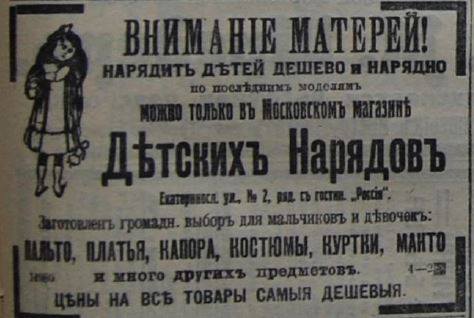
It was a Sunday a century ago. The people of Kharkiv were looking for apartments. They recalled the history of the Kharkiv floods. They were preparing for the State Duma elections and stepping down from office. They were writing petitions and closing bakeries…
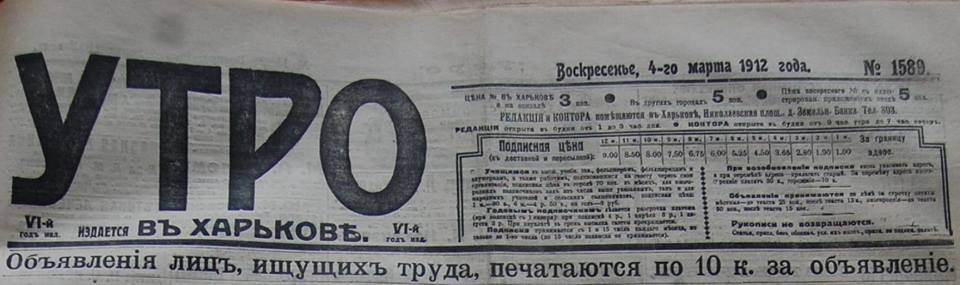
A. and Y. Alshwang Brothers, Moskovskaya Street. New arrivals. Blouses, negligees, women’s and men’s underwear. Dowries ranging from 100 to 30,000.
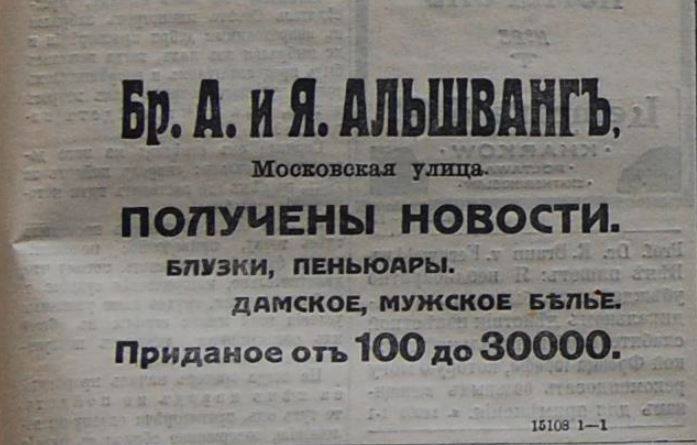
Kokovar. Coconut and walnut oil from the Libava Oil Mill (formerly Kiler). Libava, Odessa.
Easy on the stomach. It does not spoil or become rancid.
Representative office and warehouse of the Idelson Brothers Trading House. Kharkiv, Rybnaya St., 19. Tel. 420
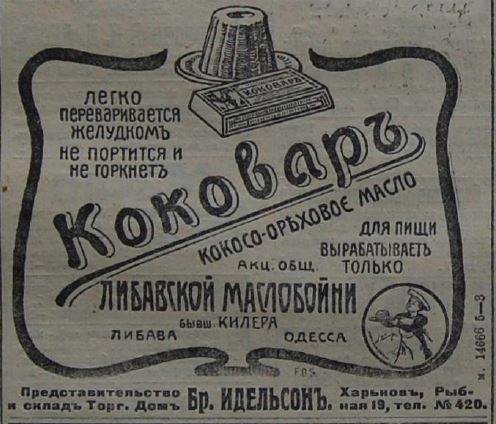
Attention, Moms!
The only place to dress your children stylishly and affordably in the latest fashions is the Moscow Children’s Clothing Store. Ekaterinoslavskaya, 2.
St., next to the “Rossiya” Hotel.
We have a huge selection for boys and girls: coats, dresses, caps, suits, jackets, cloaks, and many other items.
Prices on all items are the lowest around.
A Lecture on Vegetarianism. In early March in Kharkiv, Mr. Perper, editor of the magazine *Vegetarian Review*, published in Kyiv, will give a lecture on the benefits of vegetarianism.
We are looking for an apartment for a boys’ secondary school. Preferably: 10 to 14 rooms, a hall with a nice courtyard, available by July–August, preferably in the area of Sumskaya, Mironositskaya, and Pushkinskaya Streets; Most importantly, it should have plenty of light and fresh air. Please contact Dr. Malyshenko with any offers at 136, or in writing at 12 Mironositskaya St., private residence.
Weather in Kharkiv. Yesterday afternoon, temperatures dropped sharply. By evening, heavy snow began to fall.
“Niama” perfume. This season’s new release. It is available at the Russian Society for the Trade in Pharmaceutical Goods, as well as at all other similar stores.

Resignation. In addition to the telegram published in issue No. 1588 of *Utra*, we report that A. D. Mikhailov, director of the Kharkiv Audit Chamber, is resigning due to illness.
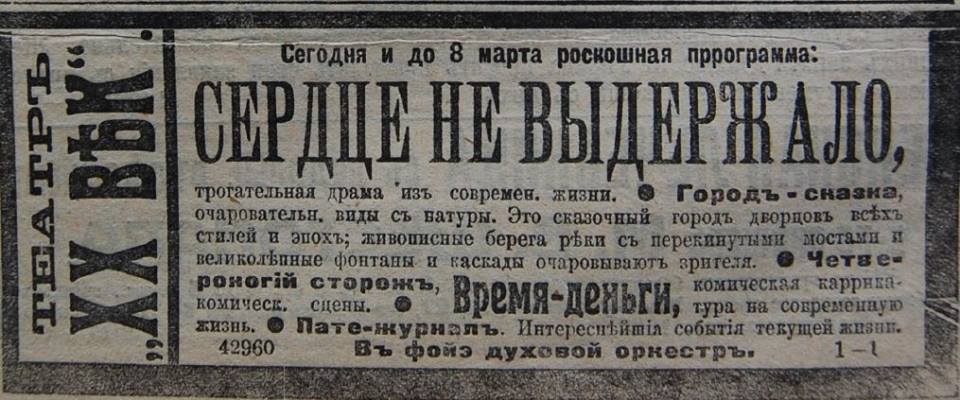
The “20th Century” Theater. A spectacular program running today through March 8:
– *The Heart Couldn’t Take It*, a touching drama set in modern life.
– “A Fairytale City,” enchanting scenes drawn from life. This is a magical city of palaces in every style and era; the picturesque riverbanks with their bridges, magnificent fountains, and cascades captivate the audience.
– “The Four-Legged Watchman,” featuring comedic scenes.
– “Time Is Money,” a comedic satire on modern life.
– “Pate-Journal.” The most interesting events of current life. A brass band will be performing
in the lobby.
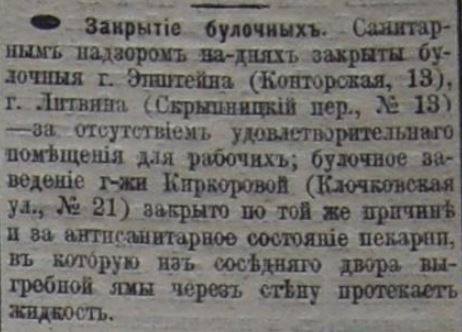
Closure of Bakeries. The health inspectorate recently closed the bakeries in Epstein (Kontorskaya Street, 13) and in Litvin (Skrypnytskyi Lane, 13)—due to the lack of satisfactory facilities for workers; and the Kirkorovs’ bakery (Klochkovskaya Street, 21)
In the tailors’ guild.
A report presented recently by the secretary of the board revealed that only a small fraction of the society’s members regularly pay their dues. It was therefore deemed necessary to select a delegate from each workshop to ensure that membership dues are paid properly and to recruit new members to the society; it was also decided to organize lectures on topics of interest to the society’s members.
Today, the Cultural and Educational Committee is organizing a tour of the university art museum for society members. Professor Sumtsov will lead the tour and provide commentary.
Clergy Meeting. On March 5 at 7:00 p.m., at the consistory building, under the leadership of Bishop Theodore of Sumy, a meeting of the Kharkiv city clergy will be held to discuss certain missionary issues.
“ELEGANT” Women’s Hat Shop.
Sumska Street, 22.
The latest arrivals are in stock.

General Meeting. A few days ago, a general meeting of the members of the Kharkiv Muslim Charitable Society was held at the Muslim Central Mosque, presided over by the mosque’s ahun, R. A. Uzbekov. A new board of directors and audit committee were elected. The 1911 report was reviewed and approved, as was the budget for 1912, which was adopted as follows: revenue from membership dues, income from the mosque, and cinema screenings: 950 rubles; expenses: 300 rubles for the upkeep of the mosque and the caretaker, 200 rubles for the upkeep of the cemetery and miscellaneous repairs, 100 rubles for subsidies, and 350 rubles for debt repayment. The report on the construction of the mosque and cemetery was reviewed. The issue of opening evening Russian language classes for Muslims wishing to learn the language in the parish school building adjacent to the mosque was also discussed. It was decided to open the courses and, for this purpose, to invite a teacher who knows Russian and is also proficient in the Tatar language.
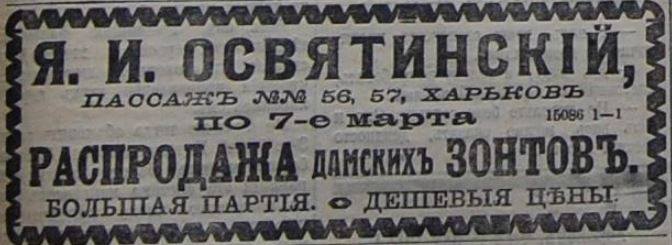
Sale on ladies’ umbrellas. Ya. I. Osvyatinsky, Passage Nos. 56 and 57, Kharkiv. Through March 7. Large selection. Low prices.
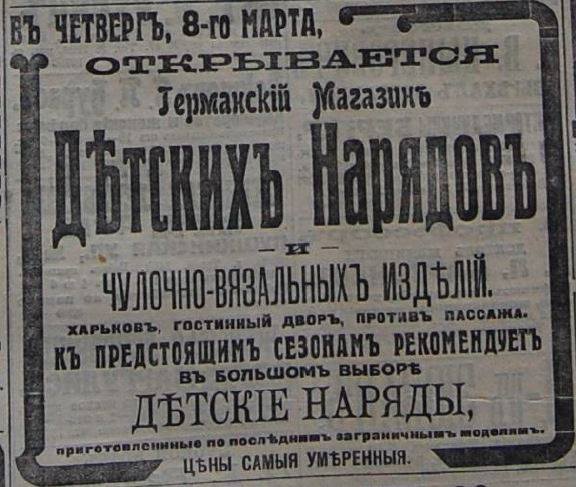
On Thursday, March 8, a German store selling children’s clothing and hosiery will open.
Kharkiv, Gostiny Dvor, across from the passage.
For the upcoming seasons, the store offers a wide selection of children’s clothing based on the latest international styles.
Prices are very reasonable.
Regarding the State Duma Elections. The governor explained to the Chuhuiv municipal administration that the one-year period of property ownership must be calculated from the moment of actual possession of the real estate until the first publication of the electoral roll (Art. 32, para. 1 of the Regulations on Elections to the State), and according to a 1893 communiqué from the Ministry of Internal Affairs, for a person to be included on the electoral roll, the value of their property must reach the established threshold by the time the electoral rolls are compiled.
Revocation of the Resolution. The Senate revoked the resolution of the Medical Department authorizing the Kharkiv Medical Society to open the 23rd standard pharmacy in the city of Kharkiv and recommended that the matter be reconsidered.
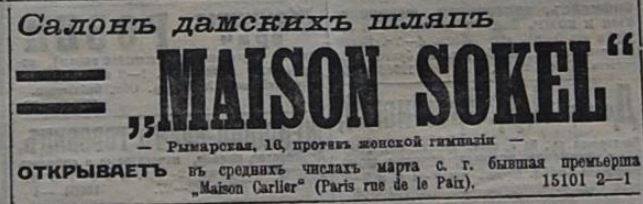
“MAISON SOKEL”
ladies’ hat shop, Rymarskaya Street, 16, across from the girls’ high school.
The former “Maison Carlier” (Paris, Rue de la Paix) is set to open in mid-March.
A new petition from the residents of Kholodnaya Gora. The residents of Kholodnaya Gora submitted the following petition, bearing numerous signatures, to the City Duma: “By allocating over 300,000 rubles to extend the tram line along Kladbishchenskaya Street, the city administration has addressed the transportation needs of residents in the northern part of Kholodnaya Gora. To meet the needs of residents in the southern part of Kholodnaya Gora, the tram line must be extended along Seminarskaya Street, which, according to the estimate, will require 80,000 rubles. Thus, constructing the Seminarskaya line will require an amount equal to only one-fourth of the capital spent on the Kladbishchenskaya line. The Seminarskaya line will carry no fewer passengers than the Kladbishchenskaya line, as it will attract residents of Novoselovka and residents of the southern part of Kholodnaya Gora—who currently use the Yekaterinoslav Tram Line—including those living in areas where institutions such as the town administration and the theological seminary are located; furthermore, during the summer, there will be increased traffic along the Seminarskaya Line to the city’s Karpovsky Garden. Consequently, we have the honor to humbly request that the council members approve the prompt extension of the Panasovskaya–Kholodnaya Gora tram line along Seminarskaya Street to the city’s Karpovsky Garden, especially since this extension is entirely in the interest of the enterprise’s profitability.”
Protest Against Deputy P. V. Kamensky. Experts and former witnesses—engineers who had participated in the Aleksandro-Sivirsky case—sent a telegram of protest to State Council member P. V. Kamensky against his statements regarding the Siversky case: “According to reports in *Golos Moskvy* and *Novoye Vremya*, you stated to the Party’s Central Committee on October 17 that the court in the Aleksandro-Sivirsky case had to contend with certain local groups that went to great lengths to obscure the case and organized an entire system of perjury for that purpose. We ask you to specify exactly which groups you are referring to and which witnesses you are accusing of perjury. Please send a telegraphic reply to this telegram within three days, by the evening of March 6, to the following address: Kharkiv, to Attorney S. A. Kozlov. Experts and witnesses: Engineer Anderson, Guard Captain Uspensky, and mining engineers Bogoyavlensky, Minenkov, Alexei Monomakhov, Pryadkin, Sergeev, Troitsky, Smidovich, Khodorovich, and Steding.”
Kharkiv Under Water: A History of Floods in Kharkiv.
Kharkiv is located in a very low-lying area. In the past, when the city was still small, only the inner part—the “Kharkiv Fortress,” where the cathedral now stands—along with Kholodna and Lysaya Hills constituted the elevated part of the city; while the rest lay amid swampy marshes in the lowlands, where the two rivers of Kharkiv—the Kharkiv and the Lopan—flow and converge. Joining them within the city limits are the tributaries Netech and Nemyshlya, which dry up completely in the summer.
Upstream from the city, a number of ravines—known as Muromchik, Maly Muromchik, and others—run alongside the Kharkiv rivers. These ravines, which trap snow, release vast amounts of snowmelt in the spring; this water rushes through our city, sometimes bursting its banks and flooding populated areas, causing incalculable disasters.
What, then, is the cause of these periodic phenomena? The extent of spring flooding is usually attributed to the amount of snow that falls in the winter, and every snowy winter already gives rise to anxious expectations. In reality, however, this assumption turns out to be far from accurate. For example, the winter of 1887–1888 saw unusually little snowfall, and yet, the spring receding of the waters proceeded quite smoothly, whereas the following year, after a nearly snowless winter, Kharkiv suffered a severe flood. The famous flood of 1853 also occurred after a winter with little snow.
Prof. Y. P. Morozov attributes spring flooding to the degree to which the soil had frozen before the snowfall, a theory confirmed by the examples cited above. In the winter of 1887–1888, snow fell on unfrozen soil, which absorbed a large amount of melted snow in the spring. In the spring of 1888–1889, however, snow covered ground that had frozen to a depth of about two arshins, and thus, after melting, the water flowed entirely into the river channels.
According to engineer A. V. Blinov, water overflows its banks as a result of debris accumulating on the riverbed, which occurs after very cold winters when rivers freeze to a considerable depth. The ice, which melts only on the surface, remains until the arrival of the so-called “Muromka” and contributes to the water overflowing its banks. Dams located both within the city itself and downstream (such as the Skuridinskaya Mill dam) also pose a significant obstacle to the free flow of spring waters.
Kharkiv’s topographical location and the devastating examples of past years keep the residents of low-lying areas in fear every year. The average resident of Kharkiv knows just how severe the flooding from these rivers—which otherwise lie stagnant—can become, and what a tremendous disaster they pose to their health and well-being.
Records of past floods indicate that the rivers in Kharkiv have flooded since 1853. Since then, this disaster struck the city in 1877, 1883, 1889, and, finally, for the last time in 1893.
We have fairly complete information about the flood of 1853. The spring flood that year began unusually early—on February 9, following a winter with little snow but very cold temperatures. As early as the first days of February, a thaw set in and heavy rains began. The water levels in the Kharkiv, Lopan, and Netech rivers began to rise rapidly and, by the morning of February 9, had reached 7 arshins above the usual spring high-water mark. The swift current carried down from the upper reaches of the rivers a huge quantity of ice chunks, trees torn from their roots, and debris from destroyed mill dams and other structures, which caused significant damage due to their force. The railings and decking were swept away from the Merchants’ Bridge; at the large Lopansk Bridge, the ice knocked down the three front arches and broke six piles. On the Kharkiv River, the large Kharkiv Bridge suffered extensive damage. A large amount of ice had accumulated under the bridge, so that the rushing water, finding no outlet, surged downward and carved a deep channel in the riverbed, undermining the foundations of the piles, while others were shattered by the ice, causing the connections to break and the bridge to tilt. Repairing this bridge proved particularly costly for the city.
A total of 346 yards belonging to private homeowners were flooded, and residents of 87 of them were forced to take refuge on the roofs of their homes. One small house was completely swept away, and a wall was breached in another. In all the flooded houses, the stoves were destroyed, fences and wattle fences were swept away by the water, and large quantities of bread and other supplies were ruined. At the Blagoveshchensk market, a stall was swept away, and goods worth 11,230 rubles were destroyed in other stalls. In total, the city’s residents suffered flood-related losses amounting to 106,236 rubles.
Less information has survived about other floods. In 1877, following a severe winter freeze, the water overflowed its banks on March 13 and reached a height of 13.6 feet. The water level during the 1883 flood was slightly lower. That year, the water reached its highest level on the night of March 17–18 and, on some streets—such as Grekovskaya and Voznesenskaya—rose to 2 sazhens above street level.
The flood of 1889 struck Kharkiv in two waves. It began on March 15, when the water level near the Kharkiv Bridge reached 13.6 feet. The flood caused great hardship for the residents; the area on the outskirts of Kharkiv was particularly hard hit, where all the basements were flooded and the gas lamps did not burn for two days due to damaged pipes. Finally, by March 20, the water had receded and the residents had calmed down, but on the 23rd and 24th, torrential rains fell and the rivers once again burst their banks.
We have the most complete information about the most recent flood to date—the one that occurred in 1893.
That year, immediately after the waters receded, the city administration’s statistics department, acting on the administration’s instructions, began a detailed assessment of the flood’s impact; student surveyors were invited to enter all flooded homes, take measurements, and ask the affected residents in detail about the extent and nature of the disaster. This information was carefully analyzed by the statistics department, and N. V. Petrov, who headed the department at the time, acting on behalf of the city administration, compiled this material and produced the brochure “Spring River Floods in Kharkiv,” published by the city in 1895.
The winter preceding this flood was snowy and, at the same time, marked by severe frosts. The water in the rivers froze to a considerable depth. In addition, the riverbeds were clogged with dirty ice and snow—mixed with manure—that had been cleared from the streets. All of this had begun to worry the residents long before the flood. But as early as February 17, warm days set in. The snow in the fields melted gradually, and the water in the rivers rose imperceptibly and receded just as quietly. But on the morning of March 6, the water began to rise rapidly, and by noon it had already flooded the Kupetsky, Kuznechny, Tsygansky (now Mariinsky), and Bursatsky bridges. By evening that day, the water had burst its banks and flooded the low-lying parts of the city.
By 8 p.m., a torrential downpour accompanied by hail and lightning had begun, and by nightfall the water had already reached 14 feet near the Kharkiv Bridge. By 5 a.m. on March 7, the water had reached its highest level of 15.2 feet. Of the 2,514.8 desyatinas occupied by the city, 528 desyatinas were flooded. Most of the flooded area was in District 1 (Zakharivka)—304.4 desyatinas. The water reached its highest level in Zhuravlevka (6 arshins 14 vershoks), but fortunately, it was not residential areas that were flooded here, but rather gardens and vegetable plots; among the populated areas, the water rose highest (up to 6 arshins) at the end of Klochkovskaya Street and near Rogatinsky Lane.
The Zakharovskaya district was hit the hardest; although the water there did not reach its highest level, it flooded a very large area of this densely populated district to a depth of up to 4 arshins.
A total of 719 courtyards were flooded in the city, and at the three markets, 1 office, 3 taverns, 388 shops, and 202 storage rooms were flooded. A total of 2,572 buildings were flooded, of which 1,080 were heated; 1,727 apartments were flooded. A total of 9,755 residents of both sexes were registered in the flood-stricken homes.
The walls, floors, stoves, and windows in most of the flooded houses were completely destroyed. In nine yards along Osnovyanskaya, Grekovskaya, and Netechenskaya Streets, as well as in Sidelnikovsky and Buzhinsky Lanes, the roofs were torn off the buildings.
Despite the thoroughness of the record-keeping, it was still not possible to determine the exact extent of the losses, simply because much of the damage was discovered after a fairly long period of time. However, even the losses that could be accounted for amounted to quite substantial figures. Repairs to buildings and apartments cost property owners 282,848 rubles, while damage to their personal property amounted to 191,740 rubles. In addition, homeowners suffered enormous losses due to vacant apartments; of the 1,727 flooded apartments, 1,206 were immediately vacated by tenants after the flood, and the total loss from the vacancy of these apartments as of May 1, 1894, amounted to 195,016 rubles. Thus, landlords alone suffered losses totaling 602,404 rubles.
The total losses suffered by apartment tenants are impossible to quantify. It is known that the poor, who are huddled in basements, have lost all their possessions.
But in addition to material losses, residents of the flooded areas paid a heavy price in terms of their health. The water rushed in at night while the residents were asleep, and one can only imagine their horror as the water flooded their apartments up to the ceiling in an unstoppable torrent. For many, this resulted in permanent health problems, and for others, even the loss of their lives. Here are a few facts reported by witnesses:
- “Somovskaya Street, 39. The flood caught them off guard: the residents were stuck in the water from 10 p.m. until 2 a.m., until help arrived in response to their desperate cries.”
- “Somovskaya Street, 41. Everything is destroyed: at night, they took refuge in the attic, which they managed to reach by breaking through the ceiling. The landlord’s wife tried to climb out the window, but her husband held her back.”
- “Ryzhovskaya Embankment, 10. A tenant and his family spent three days in the attic.”
- “Mikhailovskaya Embankment, 9. The flood caught residents by surprise; 12 people were rescued through the ceiling.”
Incidents.
A Heroic Deed. A few days ago, A. Ilchenko, a telegraph apprentice from the village of Zolochev on the North Donetsk Railroad, entered a train car while the train was stopped. When the train began to pull away and picked up speed, Ilchenko jumped out of the car, but slipped on the step and fell onto the edge of the platform in such a way that the next step would inevitably drag him under the wheels of the car. Those present were paralyzed with horror. But P. Sirotka, a gendarmerie noncommissioned officer on duty at the station, quickly ran up to the fallen man, putting himself in danger, grabbed Ilchenko, and dragged him away from the passing train, thereby saving him from certain death. His superiors are recommending Sirotka for a medal “for saving those in danger of death.”
Emergency medical services. Yesterday, an ambulance was dispatched:
- In Moskalevka, where an unidentified 40-year-old woman fell off a bridge and lost consciousness.
- To the market square, to the young woman who had fallen from a horse-drawn tram onto the pavement and sustained a laceration and contusion to her head in the fall. Upon arrival at the scene, the victim was not there, as she had been taken to the medical society.
- On Podolsky Lane, an 18-year-old girl named A. B. was found bleeding.
- On Petinskaya Street, an 8-year-old boy, E. O., was accidentally struck by a tram and sustained a laceration to his left cheek.
- To Grekovskaya Street to see a 48-year-old woman, A. Z., who was experiencing a very severe nosebleed due to arteriosclerosis.
- At Chebotarsky Entrance, 7, where a 23-year-old woman, A. M., attempted to take her own life by ingesting ammonia
Regarding the Jews. The Provincial Council for Rural and Municipal Affairs requested information regarding the composition of the Kharkiv General Craftsmen’s Board, which had unlawfully issued craftsmen’s certificates to the Jews M. Rabinsky and M. Kaplun.
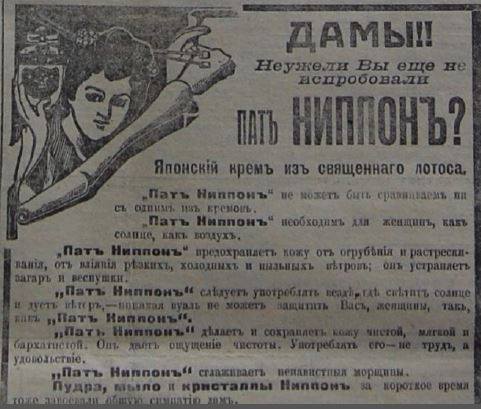
Ladies!! Have you really not tried Pat Nippon yet? It’s a Japanese cream made from the sacred lotus.
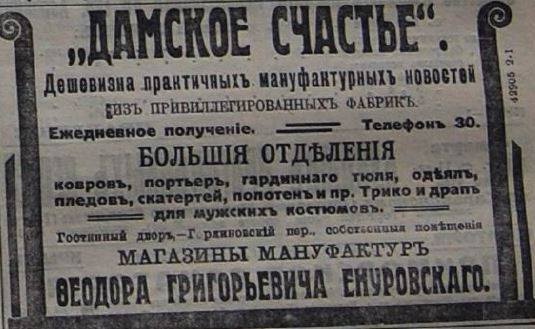
“A Woman’s Delight.” Affordable, practical goods from select manufacturers. Delivered daily. Phone 30.
Large selections of carpets, drapes, sheer curtains, quilts, throws, tablecloths, towels, and more. Tricot and drape fabrics for men’s suits.
Gostiny Dvor, Goryainovsky Lane, in our own premises.
Fedor Grigoryevich Enurovsky’s Textile Stores.
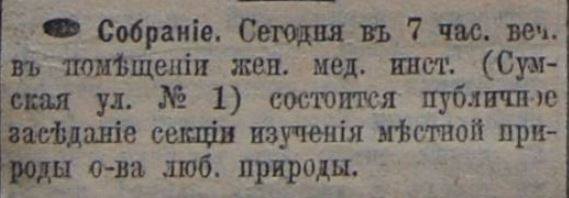
Meeting. A public meeting of the Nature Study Section of the Nature Lovers’ Society will be held today at 7:00 p.m. at the Women’s Medical Institute (Sumska Street, 1).

- About the military pilot school and the airfield in Kharkiv… - 04.11.2020
- Kharkiv Artisans and the 1887 Exhibition - 17.08.2020
- Nikanor Savich—A Political Career by Mistake - 13.07.2020