In April 1917, an interesting book for merchants and businesspeople was published in London; it was simply titled *How to Do Business in Russia*.
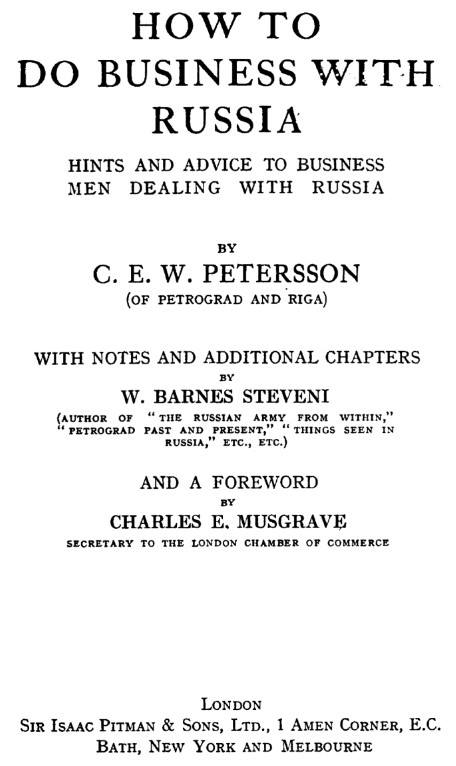
In the book, Mr. С. Peterson, an English commercial agent from Petrograd, provided descriptions of the largest cities and regions of business interest, among which, of course, was Kharkiv. World War I was still raging; the German, Austrian, and Turkish markets had been lost to Britain, and the market of this vast eastern country could become, in Peterson’s words, a “potential El Dorado” that might compensate for losses after the war ended. Western businesses viewed with great optimism the emerging prospects for reforms promised by the Provisional Government following the February Revolution. Particular hopes were pinned on the fight against corruption and the reduction of bureaucratic barriers to doing business. How did British businessmen view Kharkiv in the spring of 1917? Here are some quotes from the book:
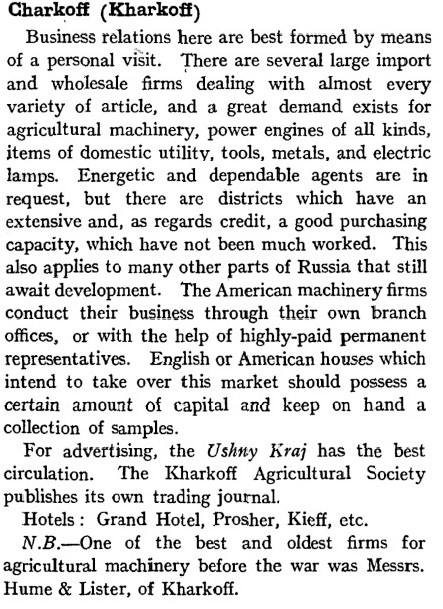
Business relations here are best formed by means of a personal visit. There are several large import and wholesale firms dealing with almost every variety of article, and a great demand exists for agricultural machinery, power engines of all kinds, items of domestic utility, tools, metals, and electric lamps. Energetic and dependable agents are in request, but there are districts which have an extensive and, as regards credit, a good purchasing capacity, which have not been much worked. This also applies to many other parts of Russia that still await development. The American machinery firms conduct their business through their own branch offices, or with the help of highly-paid permanent representatives. English or American houses which intend to take over this market should possess a certain amount of capital and keep on hand a collection of samples.
For advertising, the Ushny Kraj has the best circulation. The Kharkoff Agricultural Society publishes its own trading journal.
Hotels: Grand Hotel, Prosher, Kieff, etc.
N.B.—One of the best and oldest firms for agricultural machinery before the war was Messrs. Hume & Lister, of Kharkoff.
…There are so many horses that in Kharkiv, the Cossacks offered me a foal for 3 rubles. The horse population in Kharkiv is approximately 1,191,000!
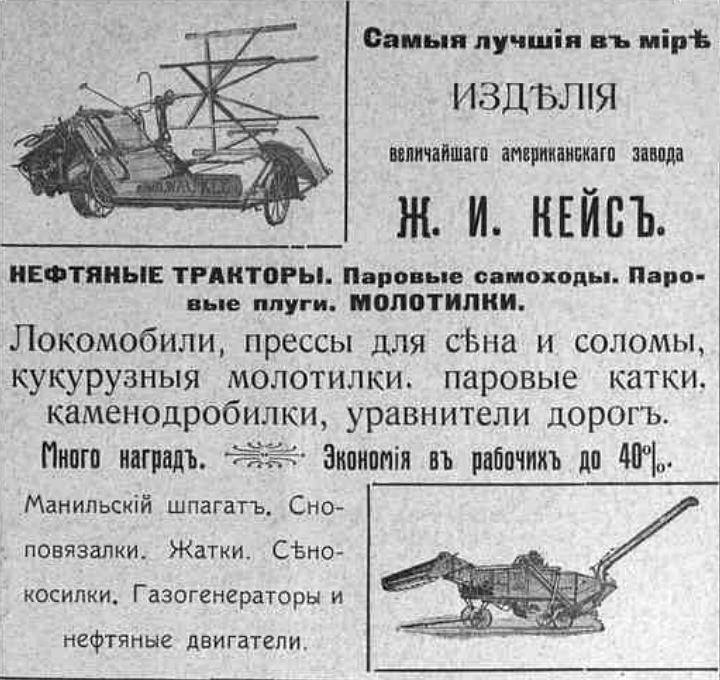
Alas, in the West (and here, too, I suppose), no one could have imagined that all these promising prospects would be destroyed in just half a year…
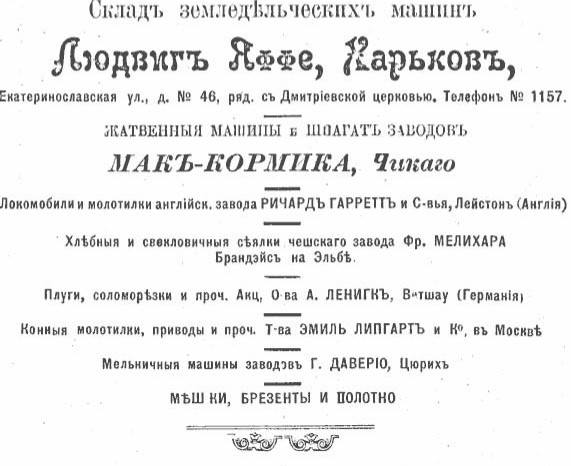
And the British Consulate in Kharkiv closed down for good and has not resumed operations in Kharkiv to this day.

- 1st Kharkiv Gymnasium - 17.09.2026
- The Oldest Movie Theater in Ukraine - 24.08.2026
- The Alkhovsky Estate - 14.08.2026