On December 26, 1874, the first specialized dog show was held in the capital of the Russian Empire, where a panel of judges evaluated 17 groups of sighthounds, 40 hounds, and 39 companion dogs. Ladies’ and working (service) breeds were also on display there (though they did not participate in the competition).
The honor of organizing this event belongs to the “Imperial Society for the Breeding of Game and Hunting Animals and Proper Hunting.” It was founded back in 1872 on the initiative of an avid hunter, Count Vasily Alekseyevich Sheremetev. This is hardly surprising, since in the 19th century, dog breeding and cynology were closely linked to hunting with hounds.
After 1874, other dog breeding clubs emerged in the country, focusing not only on hunting breeds, and dog shows began to be held in various cities until 1917.
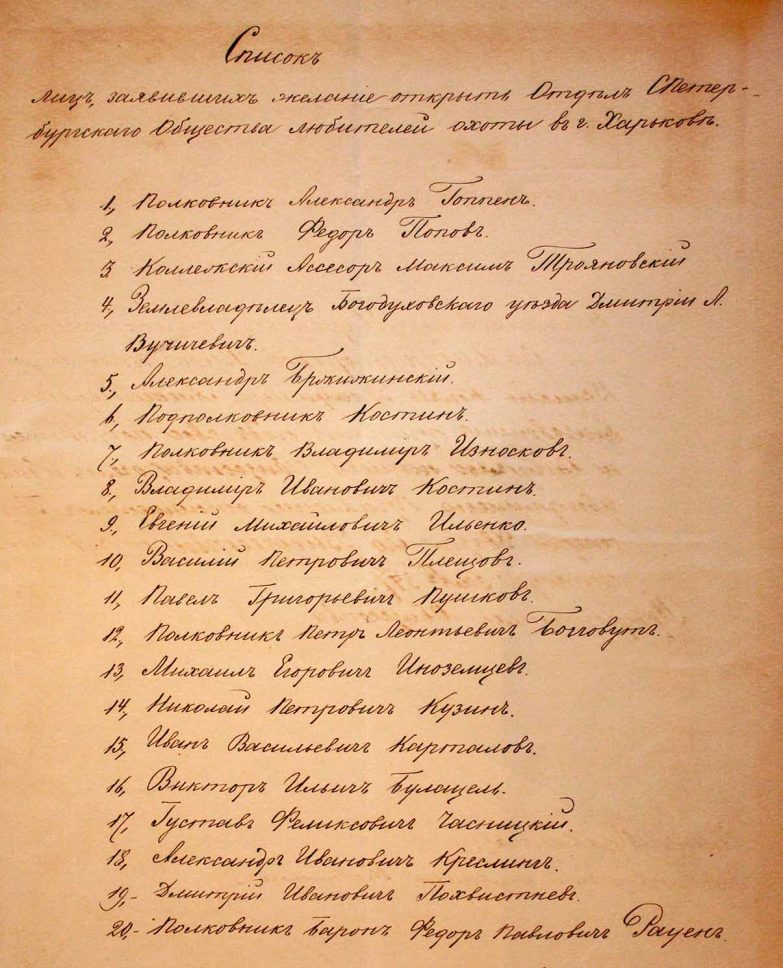
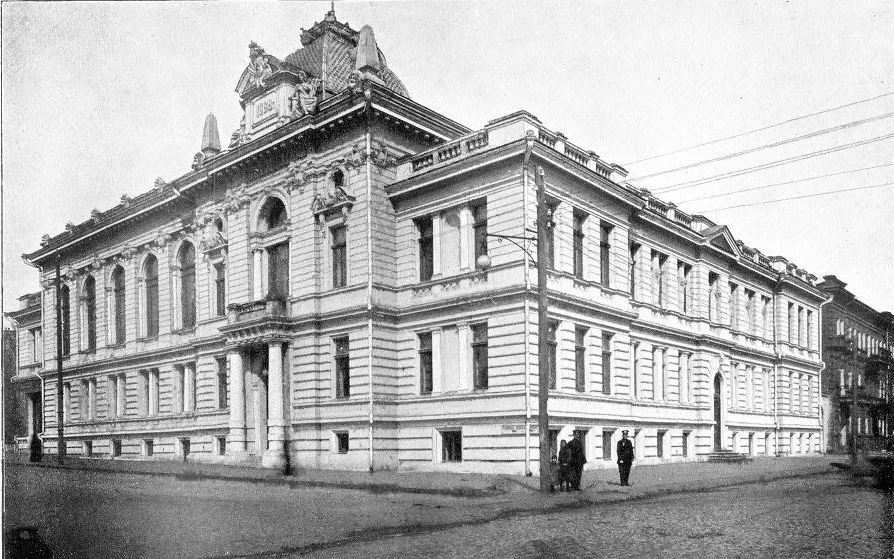
According to archival documents, a branch of the “Society of Hunting Enthusiasts” was established in our beloved city as early as 1875. Initially, it had about 20 members. And on September 9, 1881, the “Kharkiv Society of Hunting Enthusiasts” was reorganized into a branch of the “Imperial Society for the Breeding of Game and Commercial Animals and Proper Hunting.”
The organization’s charter listed among its primary objectives the proper conduct of hunting during the legally permitted season, as well as the breeding and propagation of native game and commercial animals.
And in paragraph 25 of the section titled “On the Society’s Activities,” we read:
With the permission of the local police chief, the Society organizes all kinds of shooting ranges and hunting grounds, as well as dog shows, horse shows, and equestrian competitions.
From April 21 to 25, 1911, the Kharkiv branch of the society organized the “First Hunting Exhibition of Dogs of All Breeds, Firearms, horses, and hunting equipment, featuring a section on fishing and fish farming.”
Preparations for such an important event began well in advance. As early as June 13, 1910, at a general meeting of the members of the Kharkiv branch, D. I. Goldberg’s proposal to organize a hunting exhibition in our city was approved. However, at the very first meeting, disagreements arose among the members of the organizing committee; Goldberg announced his refusal to participate in further work and withdrew from the organizing committee. Nevertheless, the remaining members of the Kharkiv branch—E. R. Lesevitsky, A. N. Vasilyev, and P. I. Kazmin—continued preparations for the exhibition. As a result, the event program turned out to be quite interesting.
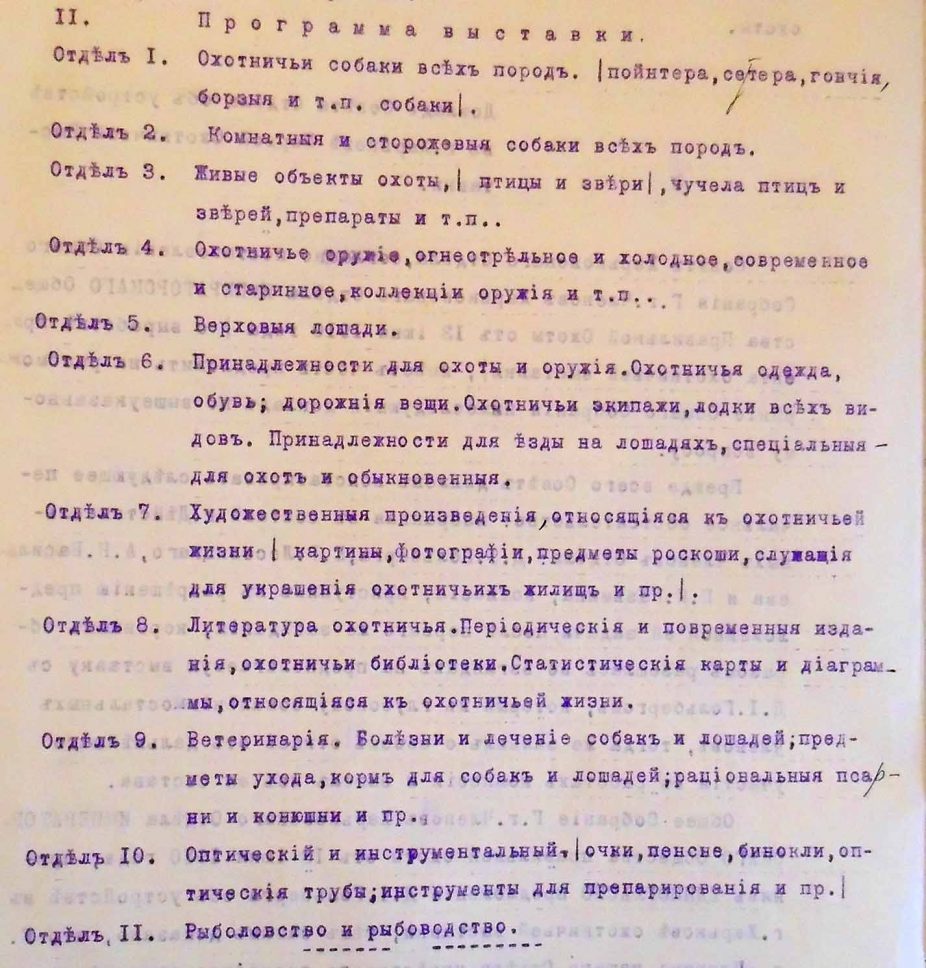
Section I. Hunting dogs of all breeds (pointers, setters, hounds, greyhounds, and similar dogs).
Section 2. Companion and watchdogs of all breeds.
Section 3. Live game (birds, animals), taxidermy specimens of birds and animals, mounted specimens, etc.
Section 4. Hunting weapons (firearms and edged weapons, modern and antique, weapon collections, etc.).
Section 5. Riding horses.
Section 6. Hunting and weapon accessories (clothing and footwear, travel items, carriages, boats, horseback riding accessories).
Section 7. Works of art related to hunting life (paintings, photographs, luxury items).
Section 8. Hunting literature.
Section 9. Veterinary science (dog and horse feed, grooming supplies).
Section 10. Optics and Instruments (eyeglasses, binoculars, telescopes, dissection tools).
Section 11. Fishing and Fish Farming.
A total of about 20 people were invited to serve as exhibition experts. Some of them were recognized authorities not only within the empire at that time, but also abroad. In their documents, the organizers noted the following regarding this matter:
By inviting experts such as K. V. Moshnin, A. V. Stolyarov, Ivashentsev, L. V. Reingardt, A. V. Poltoratsky, and others, our department will attract the interest of the public and exhibitors with this feature, establish a reputation for itself, and draw in exhibitors from other cities. It must be said that half the success of the exhibition depends on the composition of the judges.
By the way, here’s an interesting breakdown of projected expenses and revenues:
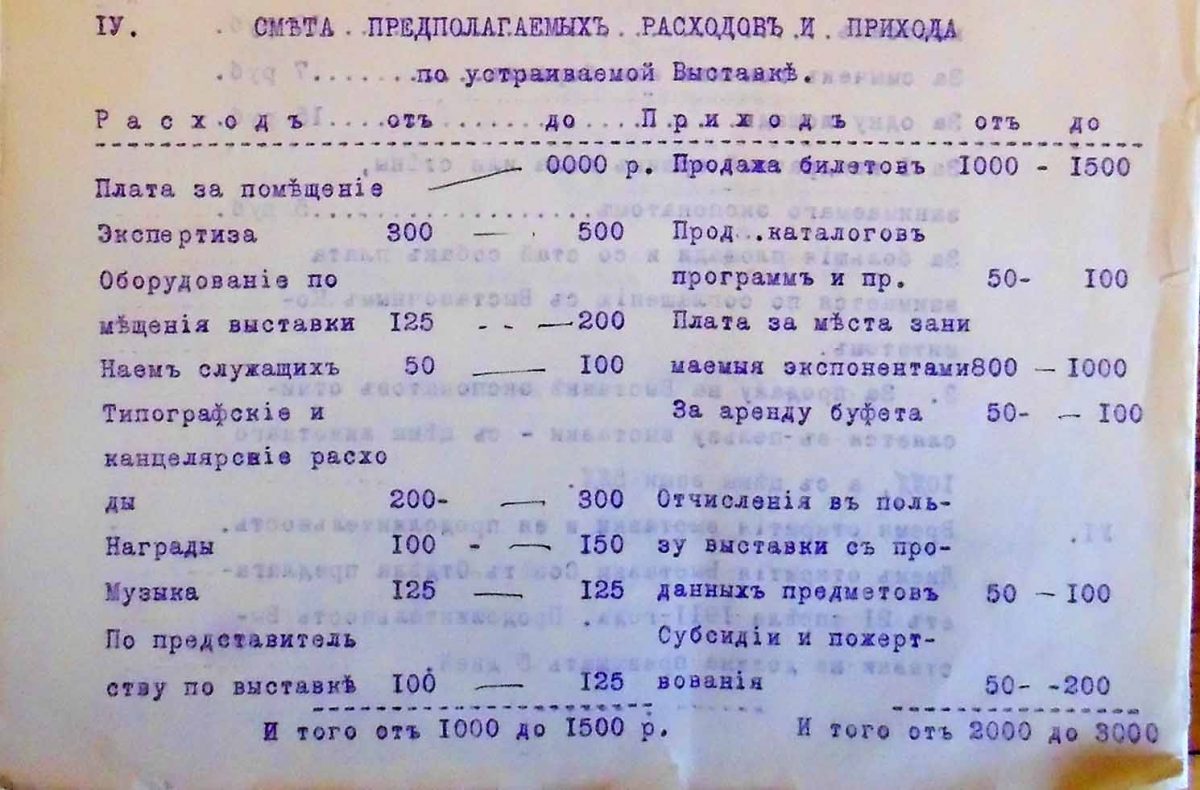
It is worth noting that the admission fee for the exhibition was 50 kopecks. Students in uniform, lower-ranking officers, and children paid 30 kopecks. On the first and last days of the exhibition, the fee was 1 ruble.
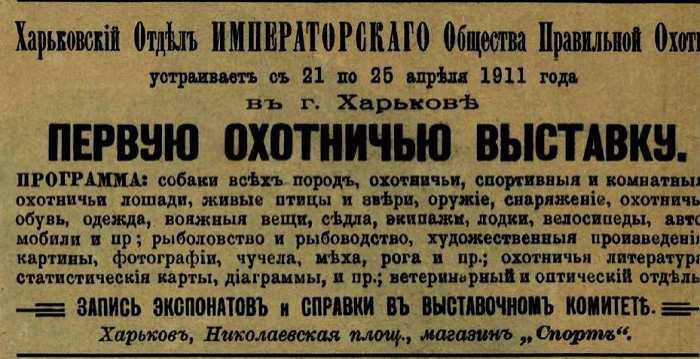
From April 20 to 24, 1913, the Kharkiv branch organized its second dog show.
The newspaper *Utro* reported on the event as follows:
Dog Show.
Today, the Kharkiv Hunting Society is opening an exhibition of dogs, guns, and hunting equipment at Tivoli Park. This is the second exhibition, and we think it will be far more successful than the one two years ago—provided, of course, that the weather doesn’t interfere. And the weather has started to look gloomy. It looks like it’s about to rain and prevent the public from seeing the exhibition.And there is plenty to see—not in the courtyard of the district administration building, where last year’s exhibition was held, but in the garden, which, even without the exhibition, offers a pleasant respite from the dust of Kharkiv. Amid the trees, a short distance from the main alley, there are enclosures for the dogs on display, as well as beautifully decorated pavilions for weapons and hunting gear.
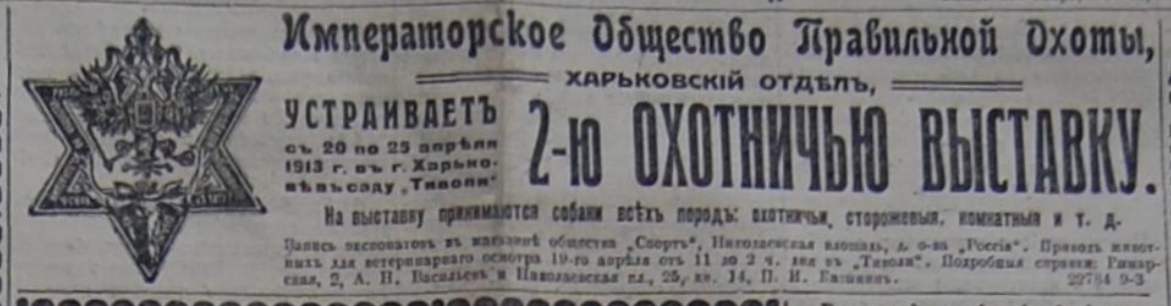
Yesterday, the dogs entered in the show underwent a veterinary examination, and it must be said that this year’s show differs from last year’s not only in the number of dogs (over a hundred) but, more importantly, in their quality. There are some magnificent specimens among them. Among the hunting dogs, setters are the most fully represented, primarily Irish setters and Laverack setters. There are also, though in significantly smaller numbers, pointers and a few ligash dogs. In addition, among the hunting dogs, there are good hounds and greyhounds, including English and even one Crimean breed. Non-hunting dogs, as might be expected, are rather poorly represented…
The weapons and hunting equipment section featured items from three stores. An orchestra also performed on the exhibition grounds, and a special pavilion was set up to display hunting and sports apparel, as well as barber shop hygiene supplies.
On opening day, the exhibition was visited not only by hunters but also by a large crowd of the public. That same day, the organizers hosted a banquet for the judges and guests at the restaurant of one of our city’s finest hotels, the Grand Hotel.
Renowned dog experts conducted evaluations during the show, the results of which were kept strictly confidential until the very last day. Journalists from Kharkiv who attended the event wrote:
Hunting dogs are the highlight of the show. They form the largest group. And the show itself is essentially a dog show…
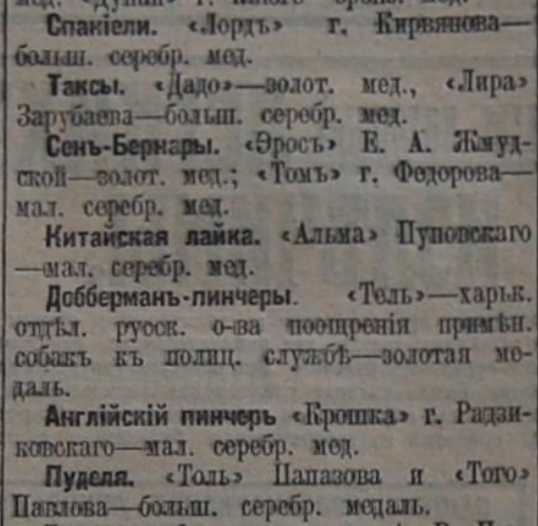
At the closing ceremony on April 24, held before a large crowd, the awards were presented in a festive ceremony. Most of the awards went to dogs of the following breeds: Pointer, English Setter, Irish Setter, and Scottish Setter. Other breeds, which were less represented, were not overlooked by the organizers either.
These days, dog shows no longer surprise anyone. That’s why it’s difficult to believe that for our ancestors living in 1911 and 1913, they were truly a major event and a grand celebration for which they prepared meticulously.

- About the military pilot school and the airfield in Kharkiv… - 04.11.2020
- Nikanor Savich—A Political Career by Mistake - 13.07.2020
- And once again, about the Cavalry Guards… - 21.01.2020