The building that now houses the Palace of Culture of the Main Directorate of the National Police in Kharkiv Oblast (Zhon Myronosyts St, 13) was once the estate of the Alchevskyi—one of the wealthiest and most influential families in Kharkiv and Eastern Ukraine as a whole.

Numerous studies and monographs have been written about the Alchevskyi family and its role in the development of industry in the Donbas, the banking sector in Kharkiv, and the advancement of Ukrainian culture and education.

Photo: Ivan Ponomarenko, 2012
This two-story Neo-Renaissance estate was built in 1891-1893 according to a design by Oleksiy Beketov on the site of the private garden belonging to Court Counselor and Professor Alexander Venediktov.
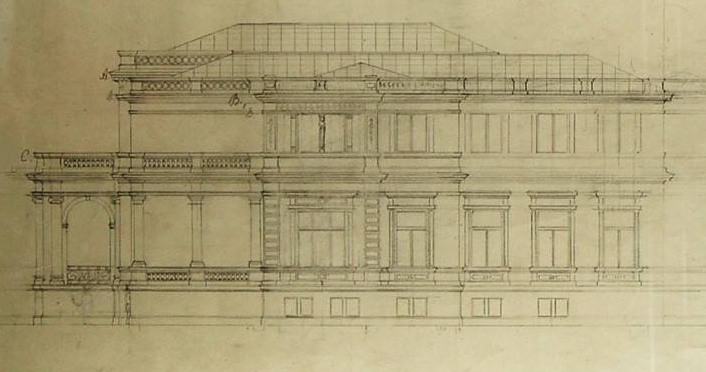
As was usual in those years, the estate was registered in the name of Alchevsky’s wife, Khrystyna Danylivna Alchevska.

The terrace balustrades, which provide access from the second floor of the estate, are still preserved along the perimeter of the roof. The mansion featured a longitudinal enfilade layout (with the formal rooms in the center and enfilades of living quarters arranged on either side).

Between the windows, one can see herms—columns topped with sculpted heads. A similar herma can also be found in the design of the House of Scientists—Beketov’s private mansion, which he built in 1896–97 next to the Alchevsky estate (the architect was married to Oleksiy Alchevskyi’s daughter, Anna).

The estate is known for housing the first monument to Shevchenko in Ukraine (sculpted by V. Beklemishev). Monuments could only be erected with the authorities’ permission, so the Kharkiv monument to Shevchenko essentially appeared in 1900 “semi-legally.” Although it was located within the grounds of a private estate, it was clearly visible from the street over a low fence. It is no surprise that poets, students, and active young people gathered at the estate, for whom the Kobzar was a symbol of the struggle for Ukraine’s independence.
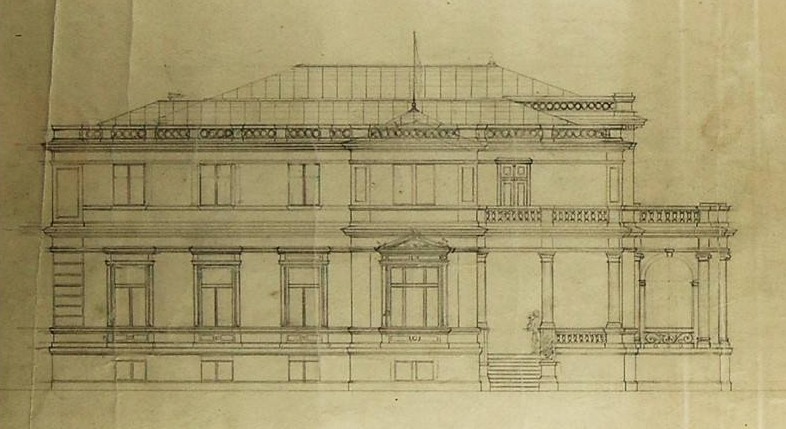
After the death of Oleksiy Alchevskyi in 1901, the estate was transferred to the guardianship of State Councilor Mykola Shabelskyi to settle the family’s debts. The monument of Shevchenko was subsequently dismantled and handed over to the Alchevskyi family for safekeeping. In the 1930s, they donated the bust to the Kharkiv Art Gallery, and since 1948, it has been housed at the Taras Shevchenko National Museum in Kyiv

Starting in 1921, the building housed the Kharkiv Cheka club. In newsreels from 1923, the famous polar explorer Fridtjof Nansen can be seen in a car against the backdrop of the estate—he was leading an international humanitarian mission to aid victims of the 1921–1923 famine.
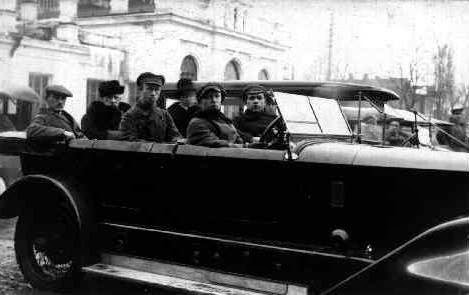
In the early 1930s, additional wings were added to the building based on a design by N. Chernomorchenko—they can be distinguished by their more modest decoration.

According to research by A. Paramonov, one of these buildings was originally a wing of the Venediktov estate (their estate from the 1830s was converted into a Constructivist building at Hryhorii Skovoroda Street, 41, by the same architect, Chernomorchenko). The former garden of the Alchevsky estate was essentially destroyed, but new trees were subsequently planted there and have since grown.

In 1945, another wing was added to the rear of the building, housing an auditorium and a movie theater.

In 1972, a museum dedicated to the military and labor achievements of the internal affairs agencies of the Kharkiv region was opened in the building—it still exists today and is now also known as the Police Museum.

In the three exhibition halls, you can find many interesting historical documents, law enforcement artifacts, and even a Ural patrol motorcycle with a sidecar.

In fact, motorcycles equipped with sidecars were already in service with the Kharkiv police as early as 1930:

Driver’s license issued to a Kharkiv driver in 1914:

Homemade weapons seized from criminals:

In 1995, a monument to Ministry of Internal Affairs officers who died in the fight against crime was erected near the Palace of Culture (sculptor: Olexander Ilyichev).

In 1997, a chapel designed by Volodymyr Novgorodov was built in the courtyard of the former estate (as part of the renovation of the gatehouse, which had previously housed the ticket office for the Palace of Culture’s movie theater).

Later, an open bell tower was built nearby, based in part on the same design.

The Police Museum is not the only museum in the building. Since 2009, it has also housed the Kharkiv Maritime Museum.

The museum’s collection is centered on ship models from various eras created by Olexander Yakimenko; it also features antique navigational instruments, maps, and other maritime-themed exhibits.