Just as it was a hundred years ago, the media bears an enormous responsibility today. After all, you must agree that it takes considerable skill to write about what happened in late June 1913 the way the journalists of the Kharkiv publication *Zhalo* did:
A breeze.
If it weren’t for the cool breeze, an ambulance would be called every day from Dmitriev’s house on Podolsky Lane.
Because of the suffocating stench spreading throughout the courtyard from a place some call the “Walter outhouse,” people faint there every day. And only the breeze helps, carrying some of the stench away to the neighbors and out onto the street, bringing relief to those suffocating from the foul odor.
The police report was less flowery and full of details:
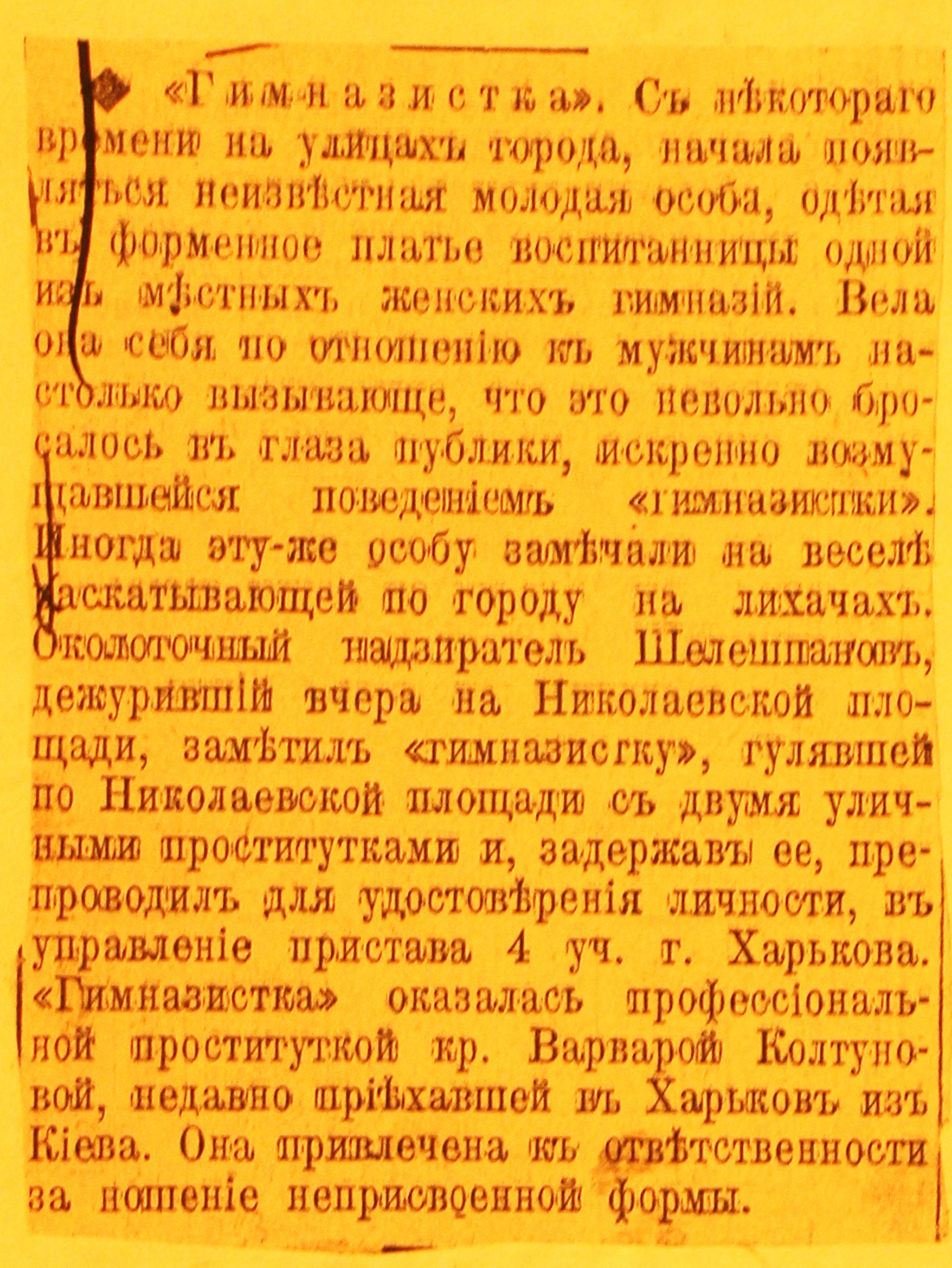
According to official reports, on June 22, 1913, Varvara Kovtunova, a 23-year-old prostitute dressed as a high school student, was detained by Kharkiv law enforcement authorities and taken to Police Station No. 4. She was carrying a passport and an appointment slip for a medical examination. Since the young woman was working legally, she was placed at the “Hungary” Hotel, her place of residence. However, a report was filed against her for wearing a “high school girl” uniform—a “grown-up” version—and forwarded to a magistrate. In principle, this situation is nothing out of the ordinary. However, thanks to an article published in the newspaper “Yuzhny Krai,” we have learned about the Kharkiv “tour” of a rather extraordinary individual.
High school student.
For some time now, an unknown young woman had been appearing on the city streets, dressed in the uniform of a student at one of the local girls’ high schools. She behaved so provocatively toward men that it inevitably caught the public’s attention, and people were genuinely outraged by the “high school girl’s” conduct. Sometimes this same individual was spotted, slightly tipsy, racing through the city on a horse. Patrol officer Sheleshpanov, who was on duty yesterday at Nikolayevskaya Square, noticed the “high school girl” walking around Nikolayevskaya Square with two street prostitutes; after detaining her, he escorted her to the bailiff’s office of the 4th Precinct of Kharkiv to verify her identity. The “high school girl” turned out to be a professional prostitute named Varvara Koltunova, who had recently arrived in Kharkiv from Kyiv. She has been charged with wearing an unauthorized uniform.”
Alas, elegant prose and compelling presentation weren’t always enough—in the Kharkiv press of the early 20th century, there was no shortage of inaccurate information under sensational headlines, all vying for “sensationalism.” Naturally, law enforcement agencies were obligated to verify such information. In the State Archives of the Kharkiv Region, one can find quite a few cases involving “truth versus falsehood.” For example, the documents from 1913–1914 are particularly interesting. Newspaper clippings are neatly pasted onto separate blank sheets of paper, with the publication, year, issue number, and date indicated, and next to them, in handwritten script, is an explanation of the actual state of affairs. Thanks to this, we can now find out which news stories—to use modern terminology—were “fake.” Although it’s worth noting that corruption existed in those days as well, and a number of situations may simply have been covered up.
Issue No. 25 of the 1913 edition of *Zhalo* featured an article with the provocative title “Rotten Meat.”
Isn’t Mr. Lelyuk, who sells at the Fish Market, charging too much (20 kopecks per pound) for rotten meat with worms?
It would be very helpful if Mr. Lelyuk would answer this question through the police, or better yet, through the public health officer.
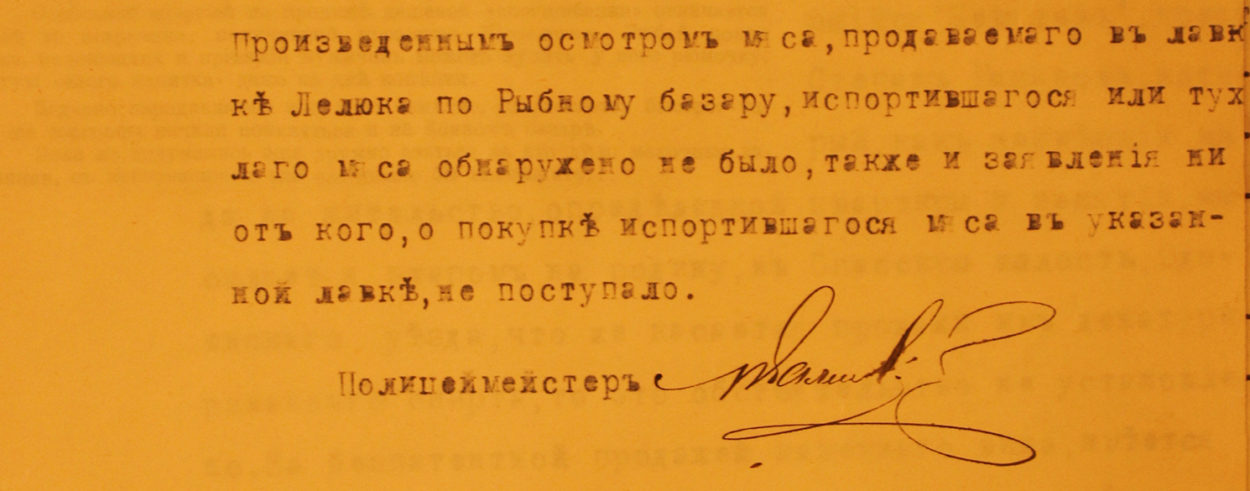
It was the height of summer, and the sun was beating down. The townspeople’s outrage at this news seemed to know no bounds. The police arrived shortly thereafter. After inspecting the spoiled goods at Lelyuk’s shop, the following facts came to light:
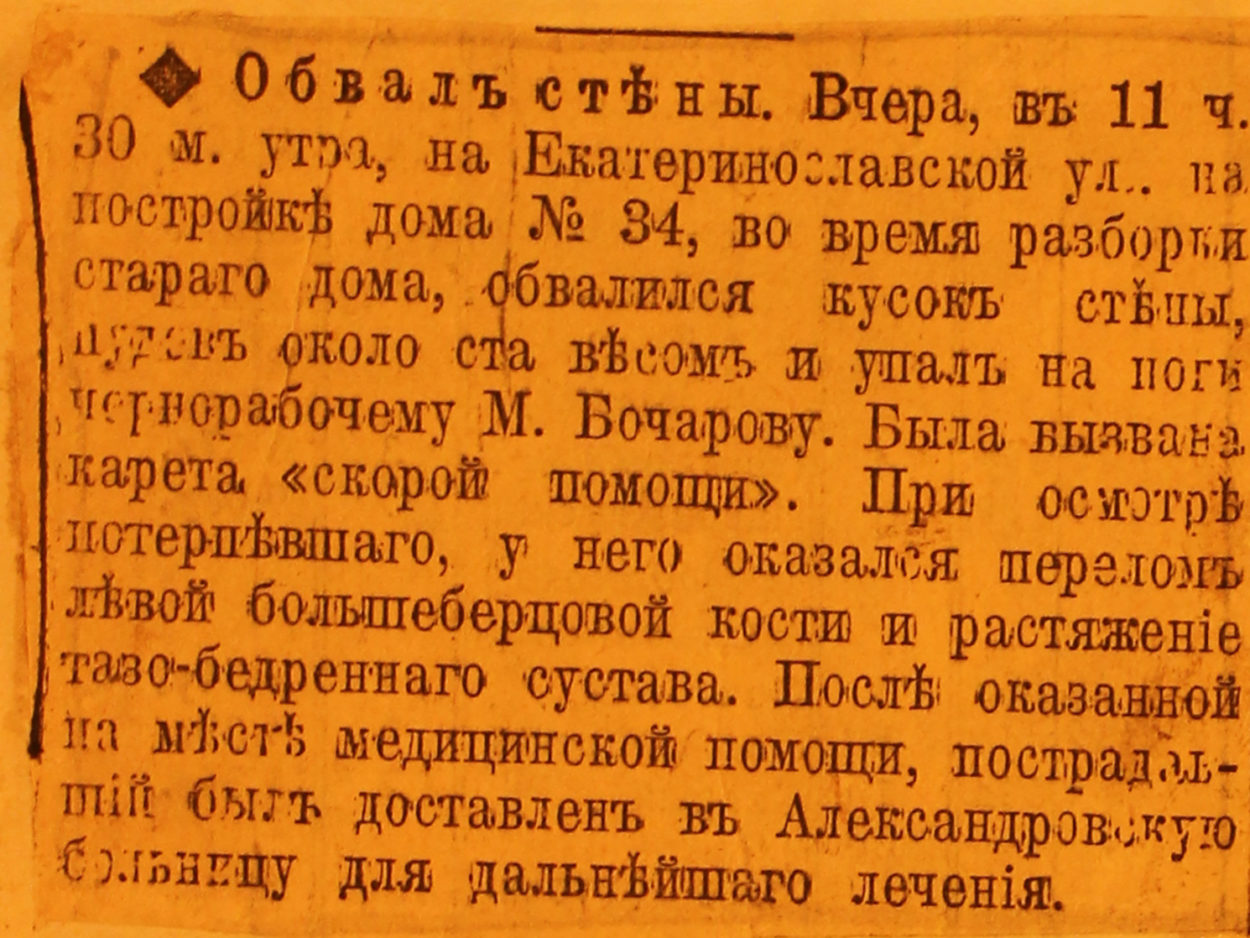
That same year, a wall of a house collapsed on Yekaterinoslavskaya Street. The police determined that the incident was the fault of a worker, and doctors classified the injuries he sustained in the collapse as minor. But that wasn’t the end of it! The newspaper *Yuzhny Krai* stunned its readers with a shocking report.
Wall Collapse. Yesterday, at 11:30 a.m. a.m., on Yekaterinoslavskaya Street, at the construction site of house No. 34, while an old house was being demolished, a piece of wall weighing about 100 puds collapsed and fell on the legs of laborer M. Bocharov. An ambulance was called. Upon examination, the victim was found to have a fracture of the left tibia and a hip joint sprain. After receiving medical attention, the victim was taken to Alexandrovskaya Hospital for further treatment.
These days, quite a few media outlets are full of alarming reports about “gang-related lawlessness” and police inaction. The same situation was observed more than 100 years ago. One of the summer articles in *Zhalo* evoked very gloomy thoughts along the lines of “how scary it is to live in this city.”
Robbers.
At the end of Kazarovskaya Street, about 20 steps from the gate leading to Pavlova’s dacha, there is a small bridge. There are no streetlights here. Taking advantage of this, every evening a crowd of hooligans and muggers gathers on and around the bridge; they attack passersby, beat them up, search them, and rob them of every last kopeck. There is absolutely no police supervision here whatsoever, and the hooligans and robbers feel right at home. The night watchmen are intimidated by them and are completely at the mercy of this rowdy gang.
After all, even the guard gets hungry, and life is good!
But what are the officials at the 2nd Police Precinct thinking?
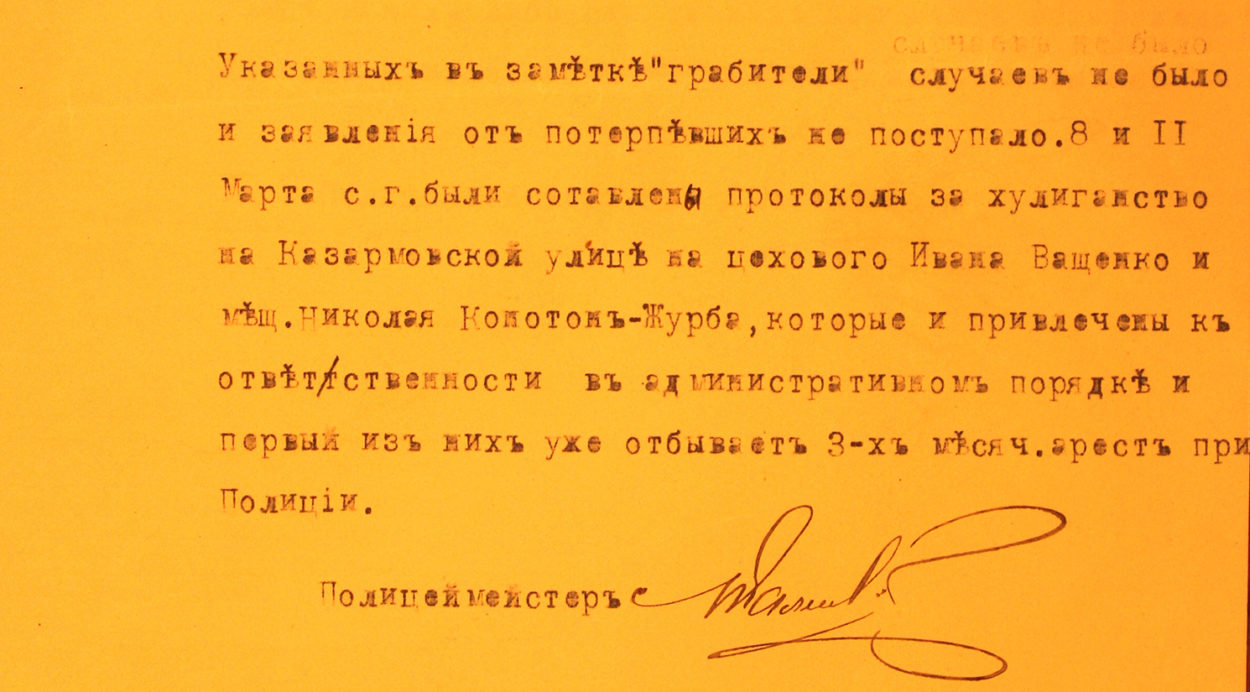
However, if we are to believe the subsequent report by the Kharkiv police chief, the officers from the 2nd Police Precinct mentioned in the article were looking in exactly the right direction. The brazen robbers described in the article did not exist, nor did the police receive a single report from the allegedly numerous victims. Only on March 8 and 11 were reports filed against two individuals for disorderly conduct on Kazarmovskaya Street, and they were subsequently held administratively liable.
The popular newspaper *Utro* also made a name for itself in August 1913. It wasn’t an article, but a full-fledged detective novel.
Attacks on sentries.
A few days ago, a hooligan struck a sentry standing guard at the military barracks at the end of S.-Moskovskaya Street with a brick.
The brick hit him in the chest, and the sentry lost consciousness for about two hours. An alarm was sounded. The garden adjacent to the barracks was cordoned off by soldiers, but the perpetrator could not be found.
The sentry claims that an old man climbed onto the fence from the garden, and when the soldier asked what he wanted, the old man threw a brick at him. A similar incident occurred near the Gelferikhovsky barracks: a stone was thrown at a sentry but, fortunately, did not hit him. The stone shattered a window in the building housing the regiment’s headquarters. The perpetrator has not been identified in this case either.
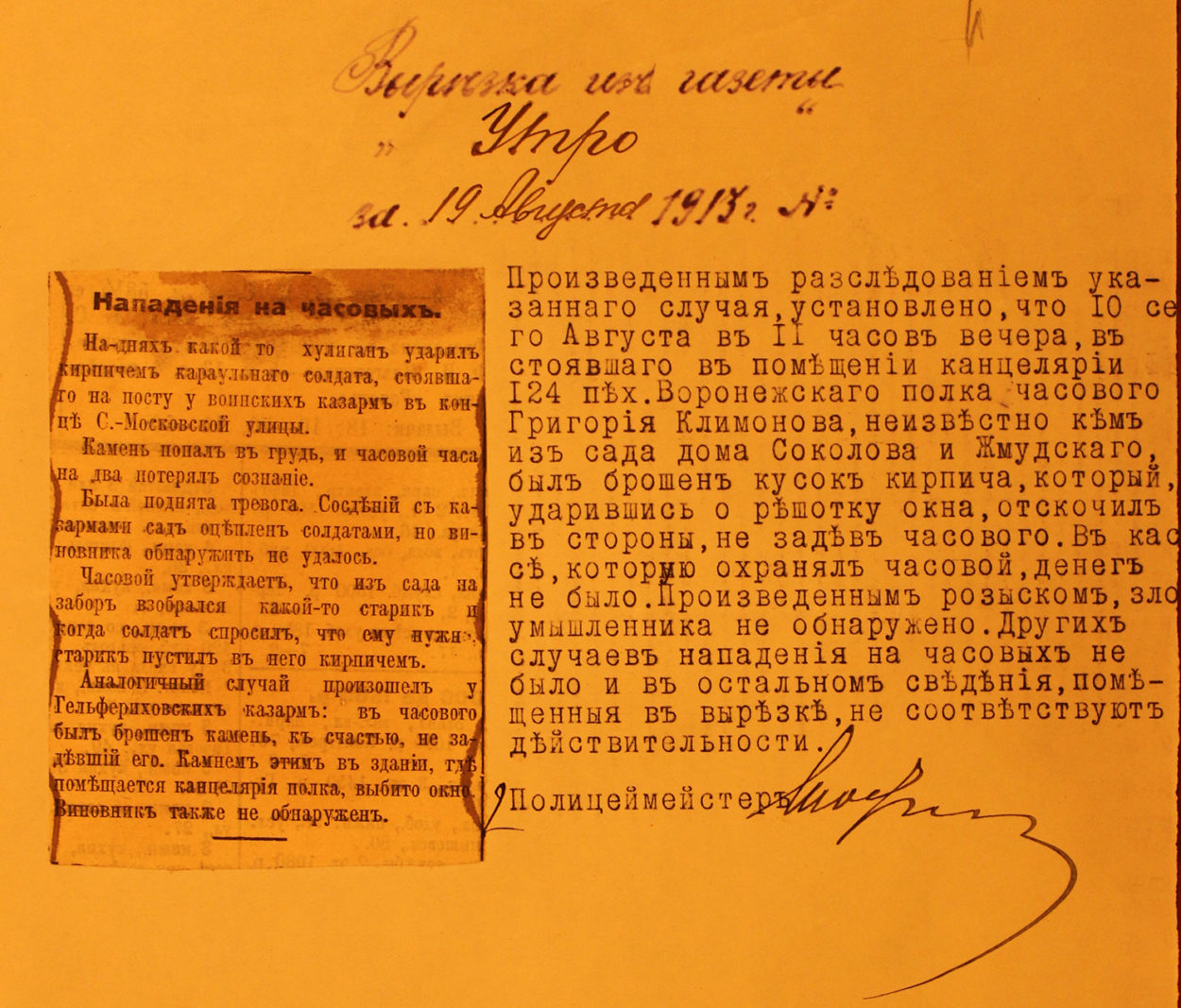
During the investigation, the police established the following: Indeed, on August 10 at 11 p.m., an unknown person threw a piece of brick from the garden of the Sokolov and Zhmudsky residence at Grigory Klimonov, a sentry guarding the office of the 124th Voronezh Infantry Regiment. The brick struck the window grille and ricocheted to the side without hitting the sentry. There was no money in the cash box the sentry was guarding. Despite a search, the perpetrator was not found. Nor were there any other incidents of attacks on sentries. Furthermore, the information contained in the article does not correspond to reality.
The issue of animal cruelty was a concern for our city’s residents even a hundred years ago. It’s no surprise that some Kharkiv newspapers capitalized on this. In one of its August issues, *Zhalo* published the following highly sentimental article.
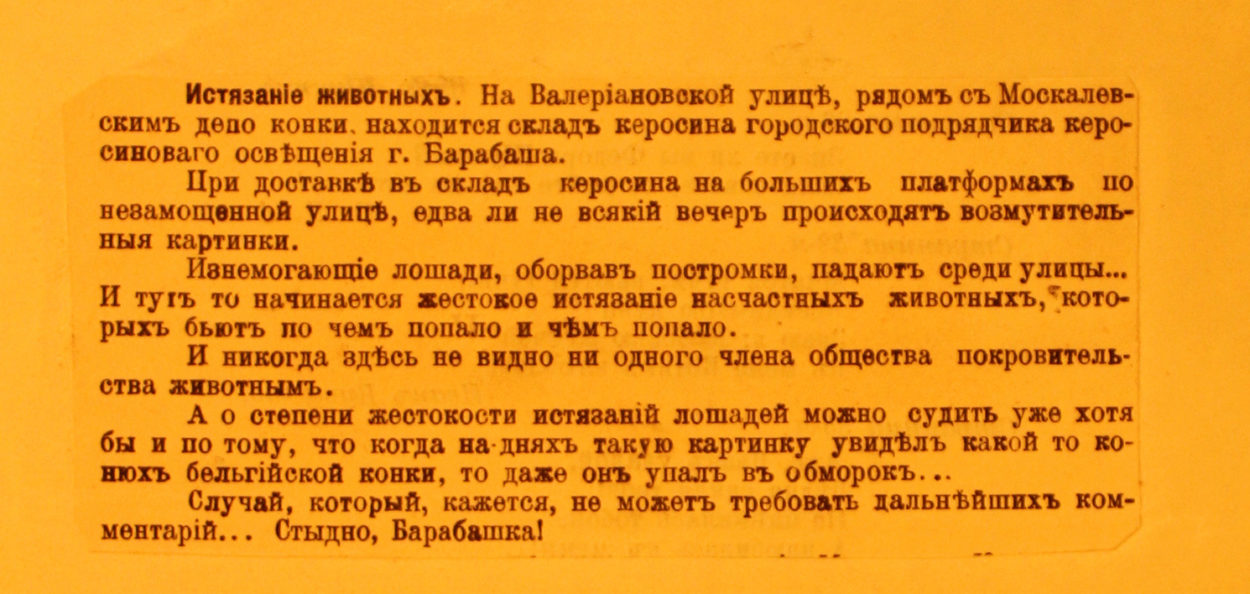
Animal cruelty.
On Valerianovskaya Street, near the Moskalevsky tram depot, there is a kerosene warehouse belonging to the city contractor responsible for kerosene lighting in Barabash.
When kerosene is delivered to the warehouse on large flatcars along the unpaved street, shocking scenes unfold almost every evening. Exhausted horses, having snapped their reins, collapse in the middle of the street… And that is when the brutal torture of these unfortunate animals begins, as they are beaten with whatever is at hand. And not a single member of the animal protection society is ever seen here.
As for the extent of the cruelty inflicted on the horses, one can judge it at least by the fact that when a stablehand from the Belgian Riding Club recently witnessed such a scene, even he fainted.
An incident that, it seems, requires no further comment… Shame on you, Barabashka!
However, the investigation revealed that no one had fainted and the animals had not been tortured, since Barabash, the owner of the kerosene warehouse in question, did not own any horses at all. His cargo was delivered by horses belonging to Pershin, a contractor for scrap-hauling carters. Pershin, incidentally, had a reputation as a good owner and had never been seen mistreating horses. Since Barabash’s warehouse was located at Valerianovskaya Street, 93, 50 sazhens from the paved road, and the path leading to it ran through loose sand, delivering cargo there was extremely difficult.
The newspaper *Yuzhny Krai* actually managed to pass off a suicide attempt as an attempt to kill a cat.
Accidental injury.
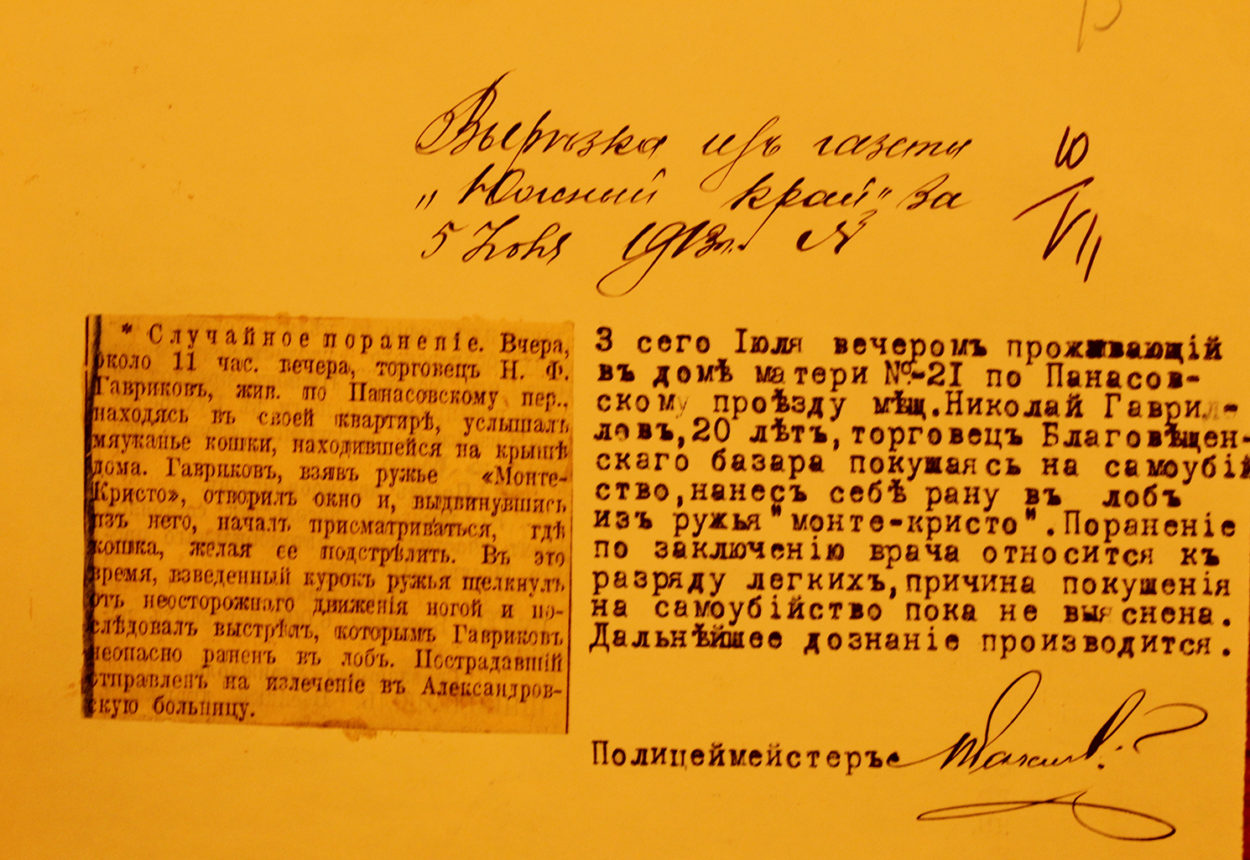
Yesterday, around 11 p.m., N. F. Gavrikov, a merchant who lives on Panasovsky Lane, was in his apartment when he heard a cat meowing on the roof of the building. Gavrikov, having grabbed his “Monte Cristo” rifle, opened the window and, leaning out, began to look for the cat, intending to shoot it. At that moment, the cocked trigger of the rifle clicked due to a careless movement of his foot, and a shot was fired, slightly wounding Gavrikov in the forehead. The victim was sent to Alexandrovskaya Hospital for treatment.
Here’s a glimpse of reality from the Kharkiv police.
On the evening of July 3, Nikolai Gavrilov, a townsman living at his mother’s house at No. 21 Panasovsky Lane, a 20-year-old merchant at the Blagoveshchensk Market, attempted suicide by shooting himself in the forehead with a “Monte Cristo” rifle. According to the doctor’s report, the injury is classified as minor; the reason for the suicide attempt has not yet been determined. The investigation is ongoing.
You have to admit, it’s extremely upsetting when someone who has decided of their own free will to end their life is accused of animal cruelty.
The issue of safety on the streets of Kharkiv was also raised in various publications. The newspaper *Yuzhny Krai*, for example, warned our city’s residents about a “dangerous sign.”
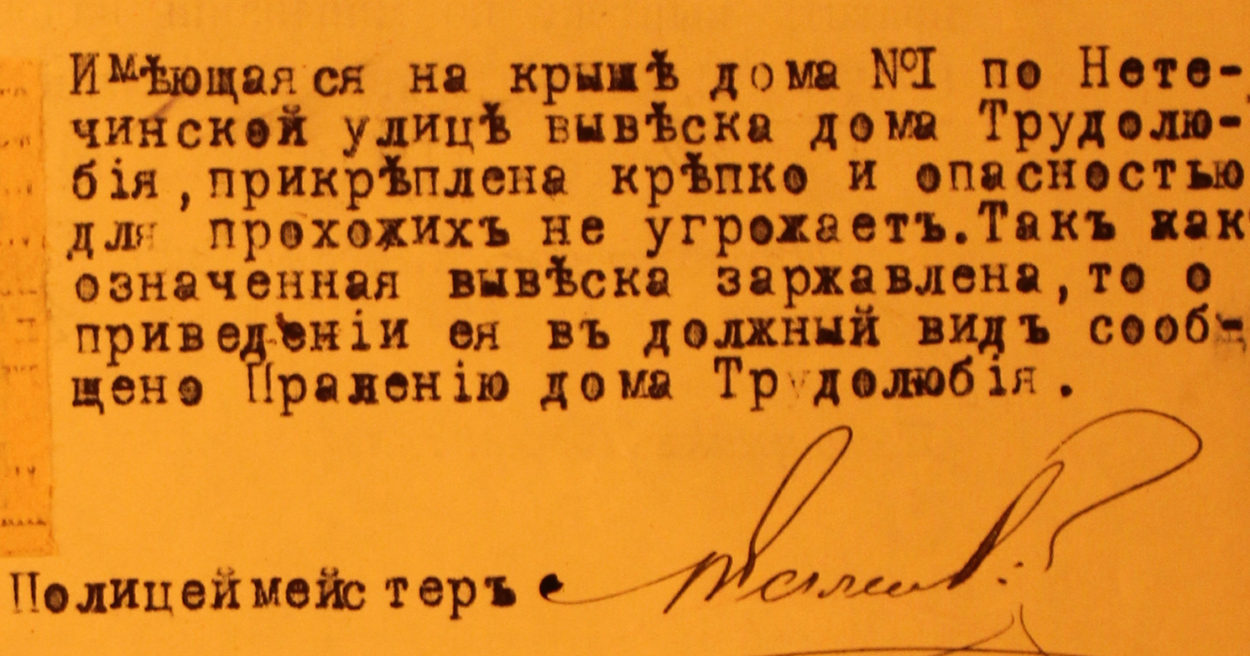
On Building No. 1, at the corner of Netechenskaya and Zmiyevskaya Streets, across from St. Michael’s Church, a large sign has been installed at the very edge of the roof for the Olginsky Children’s Work Shelter, which is housed in this building. This sign has fallen into a state of complete disrepair and sways violently at the slightest breeze, threatening at any moment to fall onto the heads of passersby. The center of the sign is completely rusted through, and a large piece of it is dangling in all directions. To prevent an accident, this dangerous sign should be removed.
The sign was never removed. After all, a police inspection revealed that it is securely fastened and poses no danger to passersby. Given that the sign in question is indeed quite rusty, the Trudolyubie building management was notified that it needs to be repaired.
However, journalists didn’t just write articles about metal signs falling on people’s heads. After all, life in general is a very dangerous thing; horrors are everywhere, and anything can fall from above.
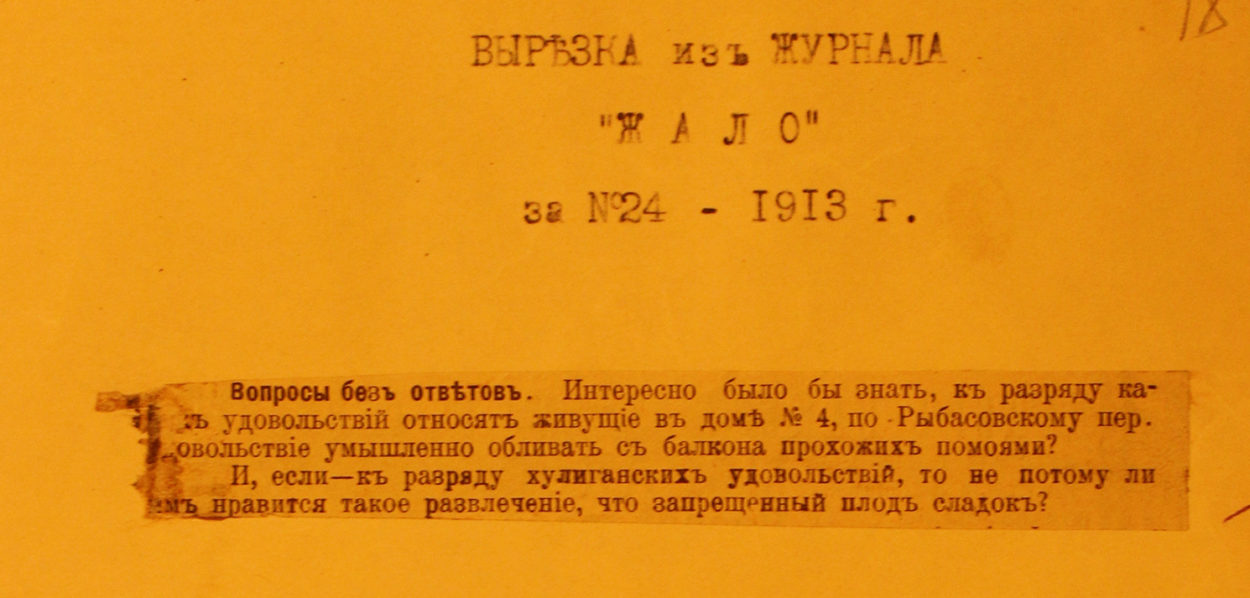
Questions Without Answers.
It would be interesting to know what category of “pleasures” the residents of House No. 4 on Rybasovsky Lane would classify the act of deliberately dousing churchgoers with slop from their balcony as belonging to.
And if it falls into the category of hooliganism, might it be that they enjoy this pastime precisely because forbidden fruit is sweet?
The real story turned out to be much more mundane. No one was splashing passersby with slop. It was simply the homeowners’ housekeeper who was wringing out rags on the balcony, for which she was immediately issued a citation that was forwarded to the magistrate of the 8th district.
Well, and how could we leave out the competition among our city’s media outlets? Some articles still amaze me with their downright exquisite “malice.” In that regard, the news in *Zhalo* is truly wonderful.
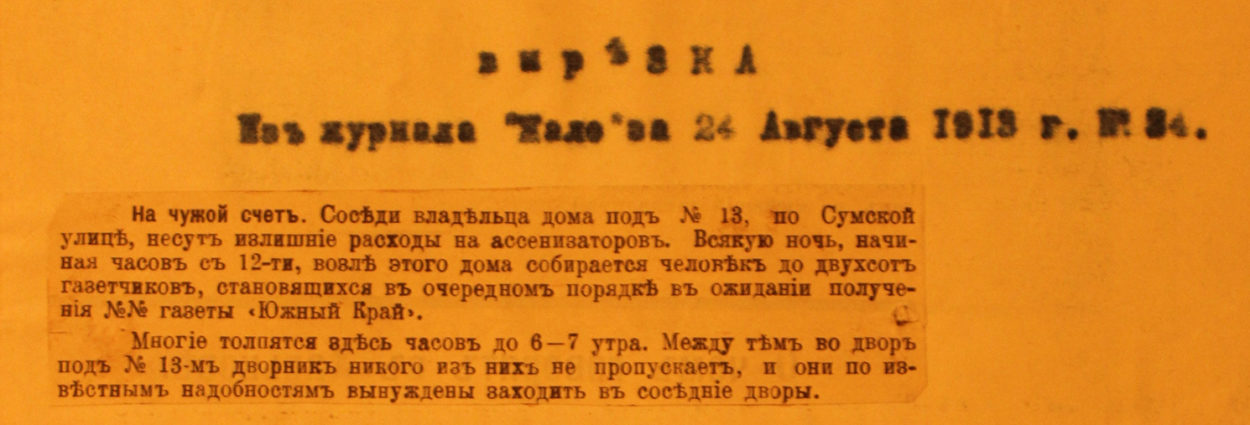
At someone else’s expense.
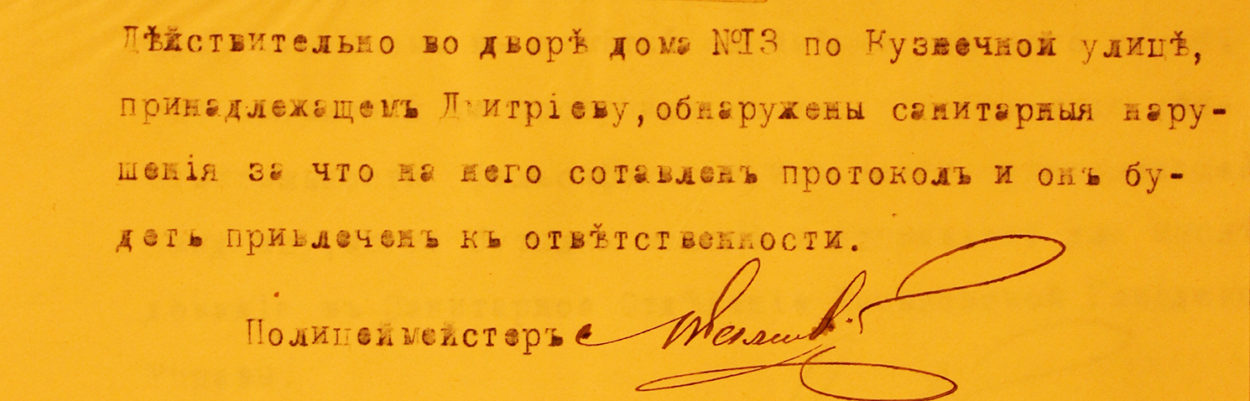
The neighbors of the owner of the house at No. 13 on Sumskaya Street are incurring unnecessary expenses for septic tank services. Every night, starting at midnight, up to two hundred newspaper vendors gather near this house, lining up in order to receive copies of the “Yuzhny Krai” newspaper. Many of them crowd there until 6 or 7 in the morning. Meanwhile, the janitor at No. 13 won’t let any of them into the courtyard, so they are forced to use the restrooms in neighboring courtyards.
So here I am, sitting and thinking. If there are 200 people, and from midnight to 6:00 a.m. at that… Just imagine what a daily deluge—and what a smell—there could be in the mornings on Sumskaya Street. Just fantastic! But the report from the valiant police—who were obligated to respond to such posts—dispelled all my fantasies.
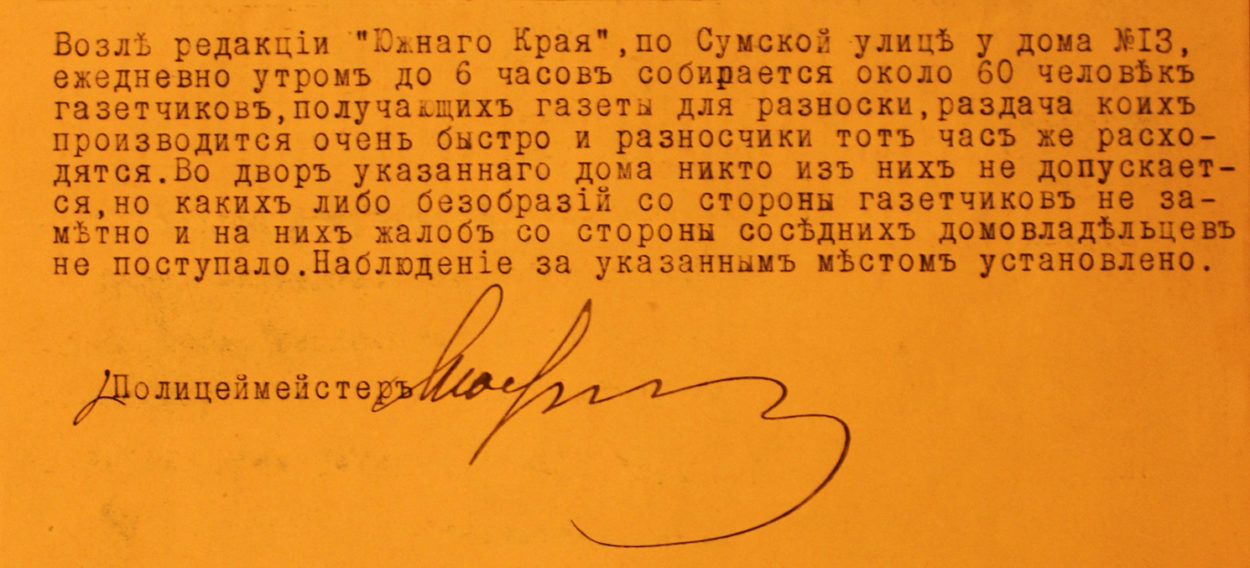
Every morning before 6:00 a.m., about 60 newspaper vendors gather near the “Yuzhny Krai” editorial office, at 13 Sumskaya Street, to pick up newspapers for delivery; the distribution takes place quickly, and the vendors disperse immediately afterward. None of them are allowed into the courtyard of the aforementioned building, but no disorderly conduct on the part of the newspaper carriers has been observed, and no complaints have been received from neighboring homeowners. Surveillance of the specified location has been established.
So, as we can see, even more than 100 years ago, our city had problems with journalistic ethics and standards, and newspapers were so eager for sensational stories that they often published downright delightful tall tales. However, whatever the case may be, the mix of truth and fiction in Kharkiv’s media in the early 20th century is also part of our history. In some cases, it’s quite amusing…

- About the military pilot school and the airfield in Kharkiv… - 04.11.2020
- Nikanor Savich—A Political Career by Mistake - 13.07.2020
- And once again, about the Cavalry Guards… - 21.01.2020