They say, “Saint Francis no longer prays. He himself has become Prayer… “And indeed, when a saint’s life is so righteous that he himself becomes Living Prayer. When a statesman’s life is so filled with service to others that he himself becomes Living Politics. When a historian is so obsessed with his subject that he himself becomes Living History… It is in this enchanting moment that a legend is born. After all, miracles, true holiness, asceticism, and selfless devotion to one’s cause frighten us. But cloaking them in legend leaves room for fiction and fairy tales…
Kharkiv is rich in legends. After all, its history is an extraordinary tapestry, woven with the brightest threads of world-historical events and the paths and fates of individuals who have left their mark on history.
What legends do we know? When did they first appear?
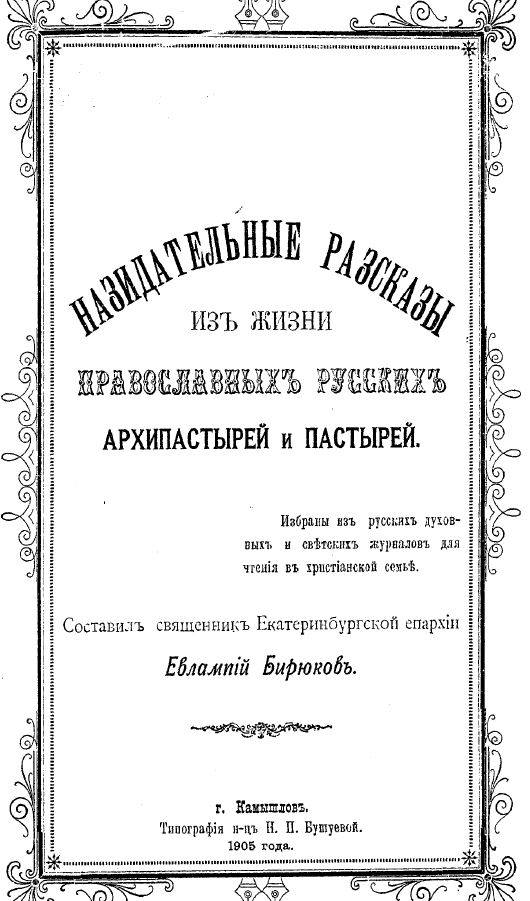
In 1905, a priest of the Yekaterinburg Diocese—Evlampiy Biryukov—wrote the book *Edifying Stories from the Lives of Orthodox Russian Archpastors and Pastors*.
In this book, we find two legends from Kharkiv, although they are more like parables. But how many such stories do we actually know that are specifically connected to Kharkiv?
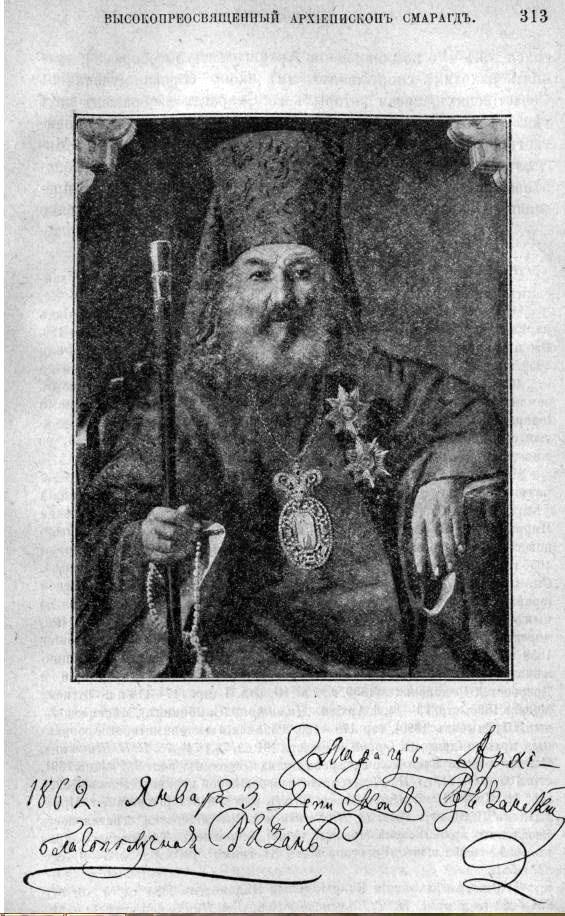
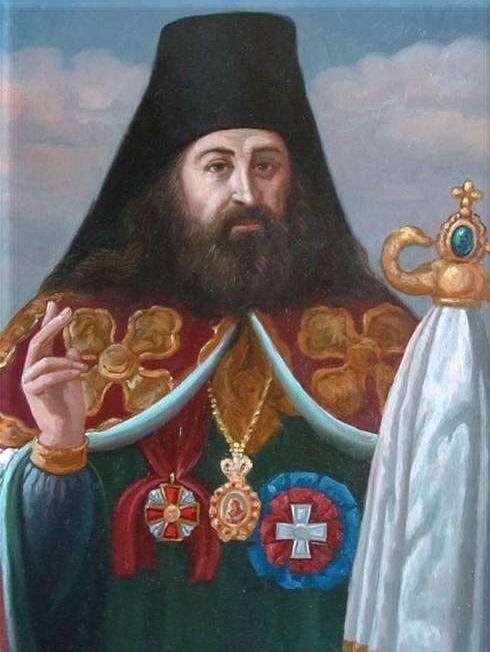
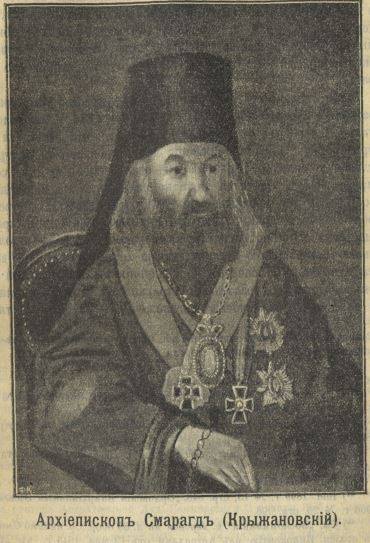
Archbishop Smaragd (born Alexander Petrovich Kryzhanovsky; 1796–1863)—a bishop of the Russian Orthodox Church, Archbishop of Ryazan and Zaraysk, and a prominent church leader—served as Archbishop of Kharkiv beginning April 6, 1840. However, on December 31, 1841, for unknown reasons, he was transferred to the Diocese of Astrakhan.
Legends about his time in Kharkiv go like this…
The two anecdotes from the life of His Eminence Smaragd in Kharkiv, presented below, are not significant in and of themselves, but they are characteristic in that they beautifully illustrate the personality of the late saint.
1) At that time, a wealthy and distinguished landowner named Bantysh the Elder—a retired general and a leading figure among the provincial nobility—lived in the Kharkiv Governorate. During his tour of the diocese, His Eminence Smaragd was to visit Bantyš’s estate; Bantyš wished to receive the bishop and treat him to a splendid dinner (for which the local nobility had been invited),—and, incidentally, to complain about “his own” priest.
Having been forewarned of everything, His Eminence arrived at the Bantysh estate at noon and, naturally, made his way first to the church, where he was met by the priest, the landowner himself, and a large crowd. The church was old and wooden, and its dilapidated appearance, both inside and out, made a grim impression on His Eminence. The bishop entered the church, said a prayer, and began to look around. He walked around the church, repeating only “Eh-heh, heh, heh!” (a sign of displeasure). He said nothing else to anyone, blessed the people, and headed for the exit. On his way out, the landowner invited His Eminence to stop by his home to rest and have something to eat, to which the latter agreed and even suggested walking to the landowner’s house, since the weather was beautiful and the distance wasn’t very far. Along the way, Bantysh showed Smaragd his “wealth,” while also showcasing his skill in farming: “Here is the orchard and the greenhouse, … here are the stone stables, and here are the cattle yard and poultry yard… and here is my home (a large two-story stone house, beautifully situated among ancient linden trees).” His Grace walked along and listened silently to the landowner; he entered the house in silence as well, and only upon entering did he ask, “Is the local priest here?” But no answer to his question followed, for the village priest had not been invited into the landowner’s house—much less to the bishop’s dinner. His Eminence was led into the great hall, where the dinner table had been set and where the assembled nobility had gathered. In the middle of the hall, His Eminence paused, silently surveying the room’s decorations and the nobles’ uniforms, and seemed not to hear the host’s repeated invitations to bless the meal and take a seat to partake of his bread and salt. Suddenly, His Eminence Smaragd addressed the host with these words: “Everything here is fine, even opulent… even luxurious… Yet I see two ruins here—you, Mr. Landowner, and the house of God on your estate. I cannot eat here. Farewell!… Have the carriage brought out.” … His Eminence quickly left the house, got into the carriage, and continued on his way.
The landowner and his remaining guests were, of course, astonished and bewildered by the bishop’s unexpected departure; but over dinner they began to heatedly discuss the bishop’s actions, speculating on various reasons and motives. Only after being left alone did Bantyš carefully reflect on the day’s events and come to the conclusion that he himself needed to set things right. Indeed, some time later, Bantysh arrived in Kharkiv and paid a visit to His Eminence Smaragd, accompanied by an architect and bearing a detailed plan for a stone church on his estate. “I knew it! Smaragd greeted him (with his usual greeting, which he used when he wished to show consideration to a visitor); I knew that you were a good Christian and, as a true Russian nobleman, would not tolerate the neglect of God’s church. Well, may God bless you! Build the church, and while you’re at it, pay attention to the priest as well: he is a hard worker, but he is in need; help him.” The landowner promised to grant this request as well; he then built the church and became a devoted admirer of Bishop Smaragd.
Man and God—there is perhaps no more complex relationship in the world.
It often happens that we run headlong away from the Almighty. After all, it’s easier not to believe. It’s easier when the Light doesn’t blind our eyes, and when it’s not there, we can’t see our own filth.
Sometimes our flight is so successful that our hearts harden and turn to stone, and it seems as though there will never be a return to the temple and to God. But the Almighty, in His infinite mercy, sends us people whose light can melt the stone of our hearts and bring us back to Him and to the temple.
Another Kharkiv legend about Archbishop Smaragd can be found in the same book:
2) Elsewhere, during the same tour of the diocese, Archbishop Smaragd had to preside over a trial involving a rural priest following a complaint filed by two officials.
At that time, a forestry system was being introduced in southern Russia and, incidentally, in the Kharkiv Governorate. A forester and his assistant—two young “first-class” officials, although the elder of the two had already been awarded the Order of St. Stanislaus, 3rd Class—arrived in a village inhabited by state peasants. In a village where there were no landowners, the young men could find a suitable social circle only in the priest’s family; they became acquainted and began to visit the priest more frequently. As difficult as this new acquaintance was for the priest, due to his weak character, he did not refuse to show hospitality and had to receive his dear guests almost daily, treating them to whatever God had provided. It was only when the quick-witted priest’s wife took advantage of a major argument between her husband and the guests one day that she showed the latter the door in broad daylight and shut the doors on them for good. The officials took offense and lodged a complaint against the priest with the dean. The dean advised the priest to apologize to … the foresters, and the priest himself willingly agreed to ask for forgiveness for the offense caused; but since the foresters refused to appear to hear a verbal apology, he had to put it in writing. But it was precisely here that the village priest, out of his excessive zeal and sincerity, ruined the whole matter. He began the apology with the following title: “Your Highborn, Gracious Lords and Knights of Various Orders” … He then candidly admitted his transgression to the gentlemen and asked for their forgiveness. When the officials received this letter, they were thoroughly outraged, seeing in the title a brazen mockery of the entire bureaucracy and even of the tsar’s awards. They learned that a bishop was traveling nearby through the diocese, so they went to him to bring a serious accusation against the priest. His Eminence, having been warned of this by the dean, listened to the complainants, read the document with its insolent title with a serious expression, and said: “Very well! Come to the city (the nearest county seat). I’ll be there soon; I’ll summon the priest and look into your complaint.” When His Eminence arrived in town, the accused priest was already there, awaiting his trial and verdict, but received only an assignment to participate in the bishop’s service at the cathedral the following day. The next day, in the cathedral, while vesting, the bishop asked the subdeacon, “Are the recipients of various orders here?” “They are here,” he was told. “Prepare the loincloth.” During the Small Entrance, the accused priest was brought before the bishop, and his cassock was removed… The “knights” see this and speculate: “Ah, they’re exposing him; they’re going to defrock him now”… but then they’re puzzled—something completely different happens: the priest is vested again and serves alongside the bishop. A neighbor who understood the matter explained to them that the bishop probably recognized this priest’s special merits, since he had awarded him a loincloth (a rarity for rural clergy in those days). Only then did the officials understand the bishop’s judgment and leave the church. After the service, as was customary, His Eminence was treated to a luncheon, to which all the city and county officials had been invited. Upon entering the house, the bishop asked again, this time loudly, “Are the recipients of various orders here?” “No,” they replied, “they were ashamed and fled first from the church, and then from the city altogether.” His Grace regretted that he had not managed to bring about a reconciliation between the young people and the “distinguished priest” before the wedding, and he seasoned the public luncheon with a bit of salt… with his discourse on how various officials often oppress and ruin priests with trifles and nitpicking, while the poor clergy neither dare nor know where to seek justice.

- About the military pilot school and the airfield in Kharkiv… - 04.11.2020
- Nikanor Savich—A Political Career by Mistake - 13.07.2020
- And once again, about the Cavalry Guards… - 21.01.2020