Many believe that the literary tradition of Kharkiv writers began to take shape toward the end of the first third of the 19th century, counting Hryhorii Kvitka-Osnovianenko among its pioneers. However, more than 200 years ago, other Kharkiv writers lived and worked in Kharkiv, and it is simply impossible not to mention them.
![CropperCapture[1]](http://moniacs.kh.ua/wp-content/uploads/2016/01/CropperCapture1.jpg)
For example, Akim Nikolaevich Nakhimov. Information about him can be found, in particular, in Nikolai Gerbel’s book *Russian Poets: Biographies and Samples*, published in St. Petersburg in 1880, as well as in the collected works of his writings.
Akim Nakhimov was born in 1782 on his father’s estate in the Bogodukhovsky Uyezd of the Kharkiv Governorate. He was educated at a boarding school in Moscow, after which he enlisted in the Mariupol Hussar Regiment. However, he soon left the military and took up a civil service position in St. Petersburg. In 1806, when Nakhimov was 24 years old, he returned to his homeland and enrolled in the Faculty of Philology at the newly founded Kharkiv University. Most of Nakhimov’s poems are associated with his university years, many of which were ironic and satirical in nature. Here is how he addressed a carpenter on the occasion of his graduation:
Ignoramuses, begone! And you, Daedalus’s great-grandson, Blum,
show your marvelous ingenuity in the art of carpentry:
Build a beautiful and enormous ark,
and most importantly, one so strong and secure that
neither time nor the flood, nor fire, nor storm, nor hail, nor thunder
—nor even rats—could damage my diploma.
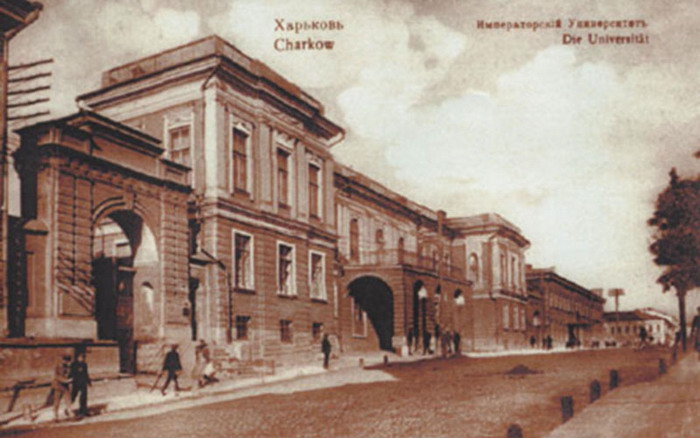
In 1809, examinations for civil service ranks were established, and Nakhimov became an instructor of grammar courses for civil servants at Kharkiv University. Around this time, he wrote his famous “Elegy-Satire,” which made him “famous throughout the Russian Empire” (quoted from Gerbel’s book).
Part of Nakhimov’s teaching method involved having his students—who were civil servants—write the poem “In Praise of the Goose Quill.” The clerks were required to bow their heads before the quill as a sign of gratitude. They were also required to write the fable “The Deacon and the Beggar”:
The Deacon and the Beggar
An old, drunken sexton took issue with a beggar: “Your nostril reveals that you’ve been snuffing tobacco;
And if I go to the authorities and report you,
According to the Code, you’ll have to say goodbye to your nose.
So if you need your nose for snuff,
Hand over your knapsack, your rags, and your walking stick to me.”
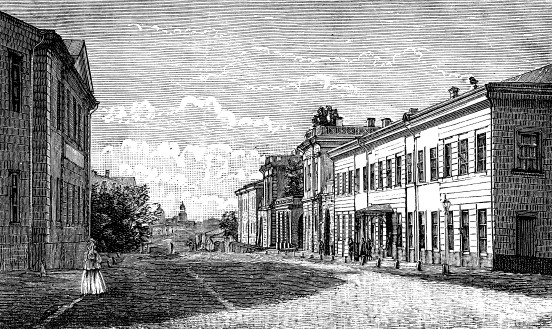
Nakhimov was not lenient with his students, and despite the importance of his position—which called for strict restraint—he allowed himself to mock them. He made future civil servants conjugate the verbs “to take” and “to beat,” as if hinting at what they would have to do in the civil service. However, as noted in the book, the students tolerated Akim Nikolayevich’s antics with patience, finding his lectures useful and conducive to “easy understanding.” In 1811, Nakhimov stopped teaching in Kharkiv because he lived on his estate and had grown tired of traveling 50 km to and from the city each time. Until the end of his life, he devoted himself to writing fables and other satirical poems. Akim Nikolaevich died young, in 1815, of consumption. Nakhimov’s works were published seven times—in 1815 (at the University Press), 1816, 1822, 1841, 1849, and 1852. No information on reprints in the 20th century could be found. It seems that Nakhimov has been forgotten. No portraits of him could be found either.
As the journal *Ukrainian Herald* wrote about Nakhimov in 1816 (it was published by Kharkiv University from 1816 to 1819), “the vices he denounced are infinitely varied in their vileness”; therefore, considerable skill was required to avoid offending the delicate sensibilities of educated people.
Akim Nakhimov’s talent was highly regarded by his contemporaries—yet has been completely and undeservedly forgotten by the current generation. Let’s pay tribute to this Kharkiv-based fabulist and satirist in one person:
For Fashionable Women
Oh, you fashionable wives! The Poet
finds you unbearable; yet he has no need of you:
Only the Graces and the Muses delight him,
while dolls hold no allure for him.The Bee and the Wasp
The wasp said to the bee:
“You have long stirred envy in me;
our kind is persecuted everywhere, while
yours is loved everywhere—
even though everyone fears your sting just as much,
and you’re even better at stinging than we are!” “I
don’t deny that we sting,” the bee replied,
“but since you love honey, how can you not love us?”The honeybee is a constructive critic;
the wasp is a brainless, spiteful detractor.With a white-painted yoke
“Who whitewashed you, Vetrana?” “Who?” “Cupid.” “Is that even possible! Has the god of love become a plasterer now?”
You can read the 1822 collection of works by Akim Nakhimov—which was digitized by Google and is part of the collection at Columbia University Library in New York—here: