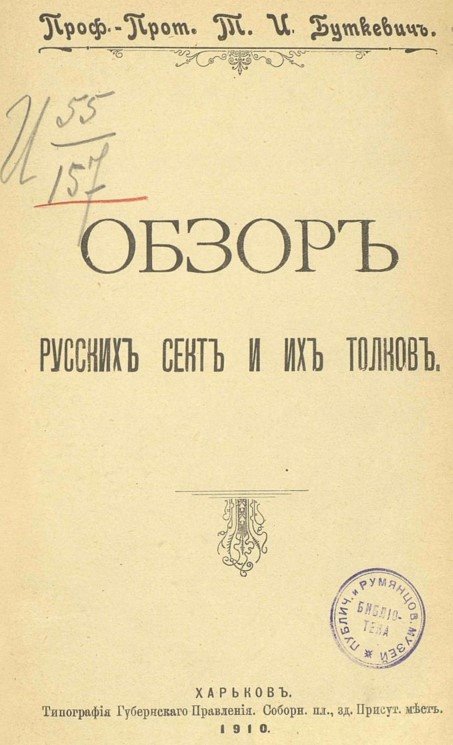
While preparing material for tours of lost churches, we came across an interesting book from 1911 titled *An Overview of Russian Sects and Their Interpretations*, published in Kharkiv by the Provincial Government’s printing house. It reveals a wealth of information about the diverse “non-canonical” religious movements of the 19th century.
It is now generally accepted that the various churches and sects that emerged in Ukraine in the 1990s represent new trends that were introduced from abroad. Nevertheless, even in the pre-Soviet Kharkiv Governorate, there was a great multitude of such movements, with very diverse roots. For example, the Shundists, who later merged into the Baptist movement, emerged among German settlers. They had been invited by Catherine II as early as the late 18th century to settle in the southern Ukrainian provinces. During the 19th century, this movement spread among Ukrainian peasants further north, reaching Kharkiv. At the same time, the peasants could attend a regular Orthodox church and then gather for a “Stunde” (from the German for “hour,” i.e., a prayer hour) to study the Bible.
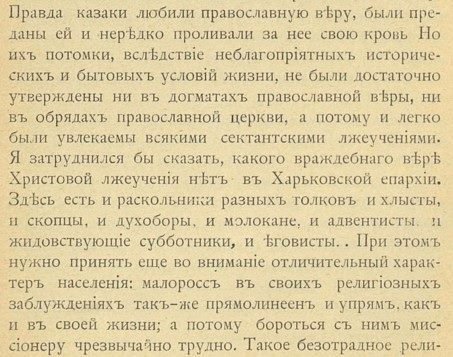
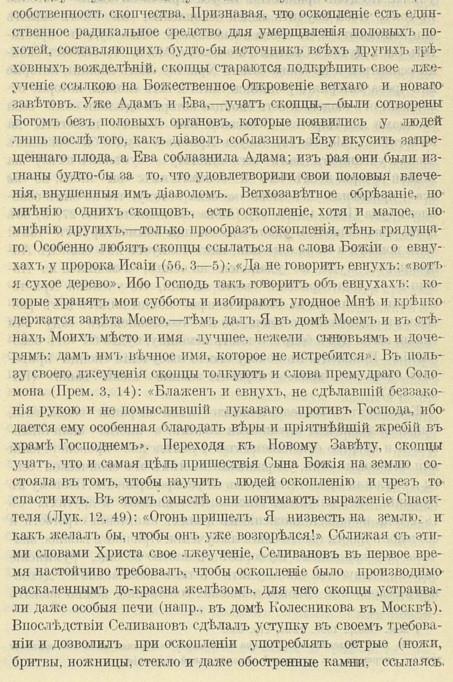
But there were also more ancient religious-mystical movements, many of which had their roots in pagan traditions—the Khlysts, the Pryguns, the Skoptsy, the Molokans, and so on. The rituals of some of these sects were wild and bizarre even by today’s standards, and we will not describe them here for moral and ethical reasons.
The Orthodox Church took these sects very seriously and carried out targeted missionary work among the advocates of both new and old religious movements. At the same time, for example, it was noted that in order to debate the Shundists, a missionary priest needed to be extremely well-versed in the Holy Scriptures, since the Shundists knew them very well and a verbal duel with them was akin to a game of chess.
It should be noted that after the 1905 Revolution, a decree titled “On Strengthening the Principles of Religious Tolerance”—which was of paramount importance to the country’s religious life—was issued, significantly easing the persecution of both people of other faiths and “unrecognized” churches and sects. But just a few years later, another revolution—the October Revolution of 1917—would take place, and persecution would flare up with a new, unprecedented intensity…

- 1st Kharkiv Gymnasium - 17.09.2026
- The Oldest Movie Theater in Ukraine - 24.08.2026
- The Alkhovsky Estate - 14.08.2026