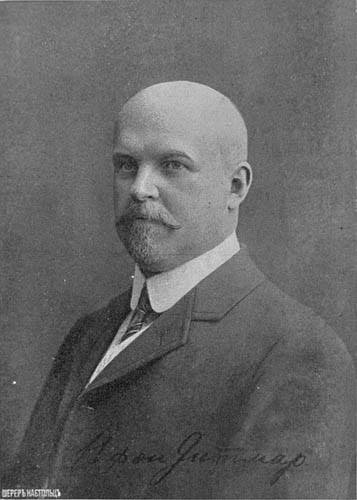
The year 2015 marked the 150th anniversary of Nikolai Fedorovich von Ditmar’s birth.
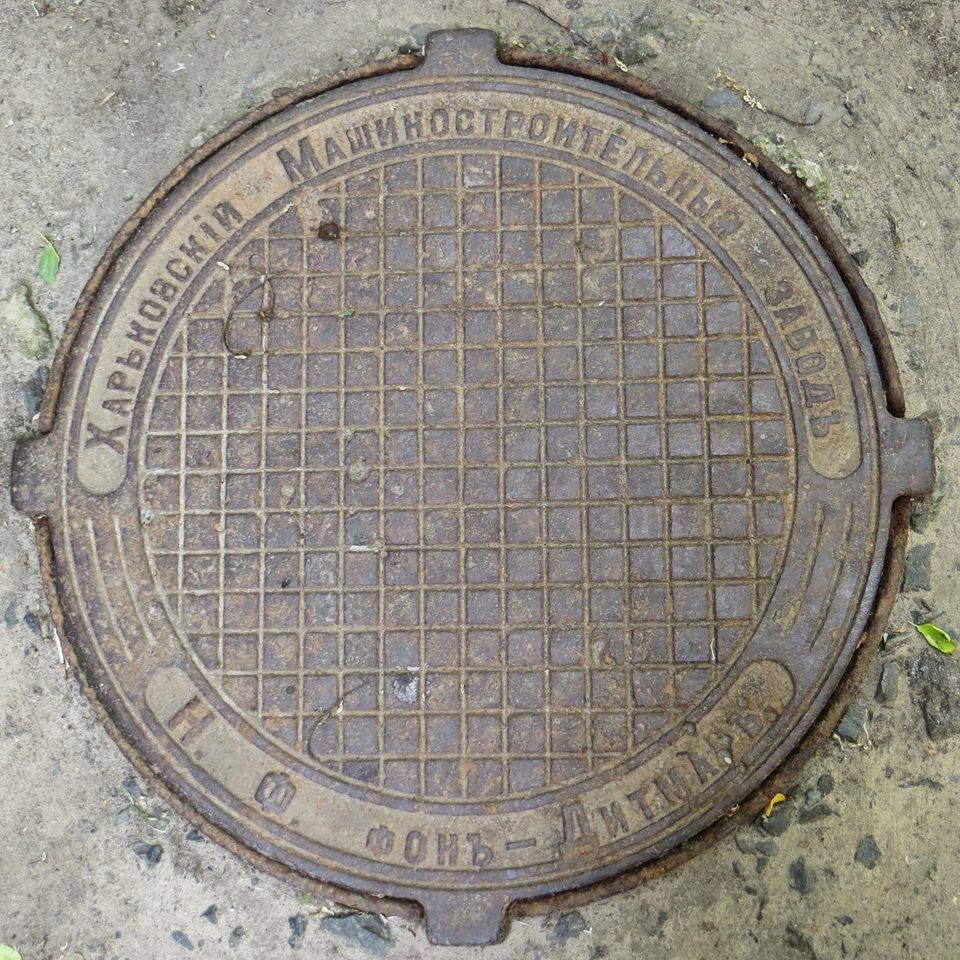
Back in 1893, Nikolai Fedorovich von Ditmar, a 28-year-old student of D. I. Mendeleev, opened a machine shop in Kharkiv. The long journey from a small enterprise with 10 workers to becoming the “Kharkiv Machine-Building Plant” with a staff of over 300 workers and employees was just beginning. Although to modern Kharkiv residents, von Ditmar’s brainchild is now known by a different name—the “Svitlo Shakhtarya” plant.
His experience as an entrepreneur convinced him of the need for engineers, managers, and businesspeople to study a specialized field—accounting. In 1907, he wrote and published in Kharkiv Russia’s first textbook in this field, *Fundamentals of Accounting*, which he dedicated “to the memory of the great teacher D. I. Mendeleev.”
Nikolai von Ditmar was an entrepreneur who not only earned a living himself but also looked after his workers. He initiated the creation of hospitals to treat occupational diseases among miners (now the Sitenko Institute), mine rescue teams, schools, and chemical and seismological laboratories to improve safety in the mines.
In his book *The History of the Russian Revolution*, Lev Davydovich Trotsky refers to Nikolai Fyodorovich von Ditmar as “the leader of Russia’s heavy industry.”
What were the reasons that led a Kharkiv industrialist to be awarded such a “title,” even in the eyes of a 20th-century revolutionary figure?
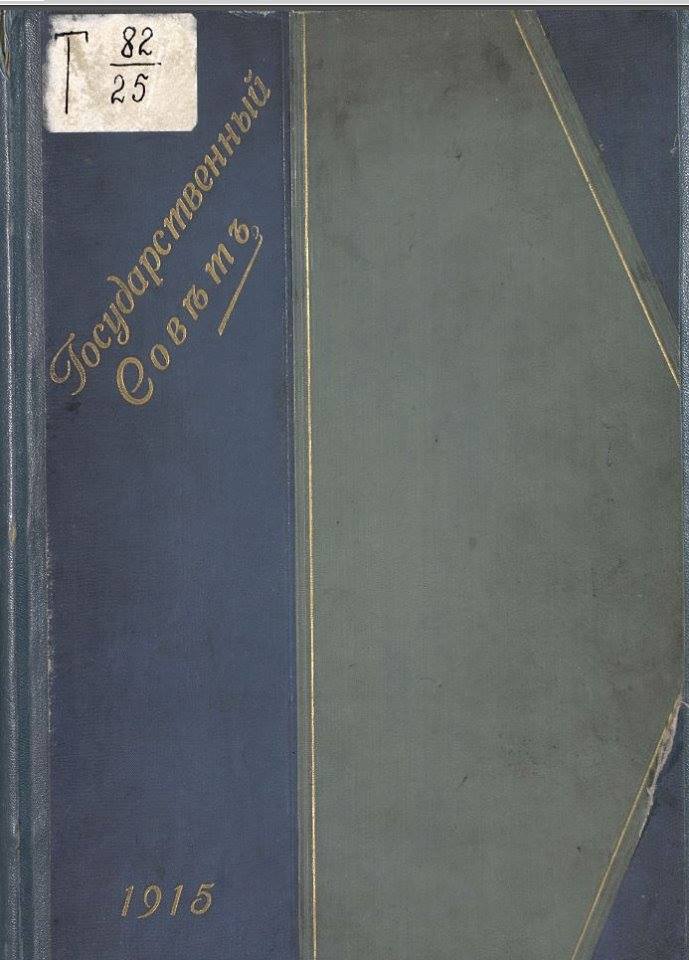
In the 1915 book *The State Council: Portraits and Biographies*, we can also find von Ditmar’s biography, which includes the following interesting description: “One of the most prominent representatives of commerce and industry in the State Council.”
Having participated since 1893 in the work of the Congresses of Mining Industrialists of Southern Russia, N. D. undertook, in 1896, at the Congress’s request, the organization of the Congress’s statistical bureau and, from that year onward, has continuously participated, directly, in all the work of the Congresses of Mining and Industrialists of Southern Russia, laying the foundations for the Congress Council’s vast statistical publications (both current and periodic) and gradually holding the positions of: head of the statistical bureau, secretary of the Council and the Congress, administrator of the Council’s affairs, member of the Kharkiv Provincial Council for Factory and Mining Affairs, member of the General Council of the State Chamber, member of the Kharkiv District Committee and the Committee on the Export of Mining and Industrial Goods, and, finally, from 1905 onward, Chairman of the Council of the Congress.
Throughout all these years, N. D. has participated in the work of the Congresses of Mining Industrialists, chairing various committees of the Congress and overseeing the study of many economic and industrial issues, including: local taxation of industrial enterprises and local electoral reform, railroad tariffs, customs tariffs, industrial taxes, subsoil rights in connection with the fragmentation of land ownership, labor legislation, and especially workers’ accident insurance, among many others. Beginning in 1903, N. D. took on the role of editor of the Council of Congresses’ official publication—the journal *Gornozavodskiy Listok* (now *Gornozavodskoye Delo*)—in which he published numerous articles on various economic, technical, and industrial issues.
The activities of the Congress Council gradually expanded, and under N. D.’s direct leadership, various departments of the Congress Council were established: statistical, railway, technical, legal, workers’ accident insurance, health, and others; the following institutions were founded: —a medical-mechanical institute with a clinic for miners, a rescue station, a school for mine foremen, a first-class seismic station, a health organization (doctors and a bacteriological laboratory), and so on. From 1898, N. D. served as a member of the board of the Society for Assistance to Miners, holding the position of chairman of the Society’s board for about 10 years. Since 1901, N. D. has been a councilor of the Kharkiv City Duma. From 1907 to 1912, he served, upon election by the City Duma, as a member of the Kharkiv Provincial Trade Tax Commission. Since 1901, he has been a member of the audit committee of the Kharkiv branch of the State Bank; since 1905, he has served as chairman of the Kharkiv branch of the Imperial Russian Technical Society, chairman of the accounting department he organized, and editor of the journal “Accounting and Management,” in which N. D. published several articles on accounting issues.
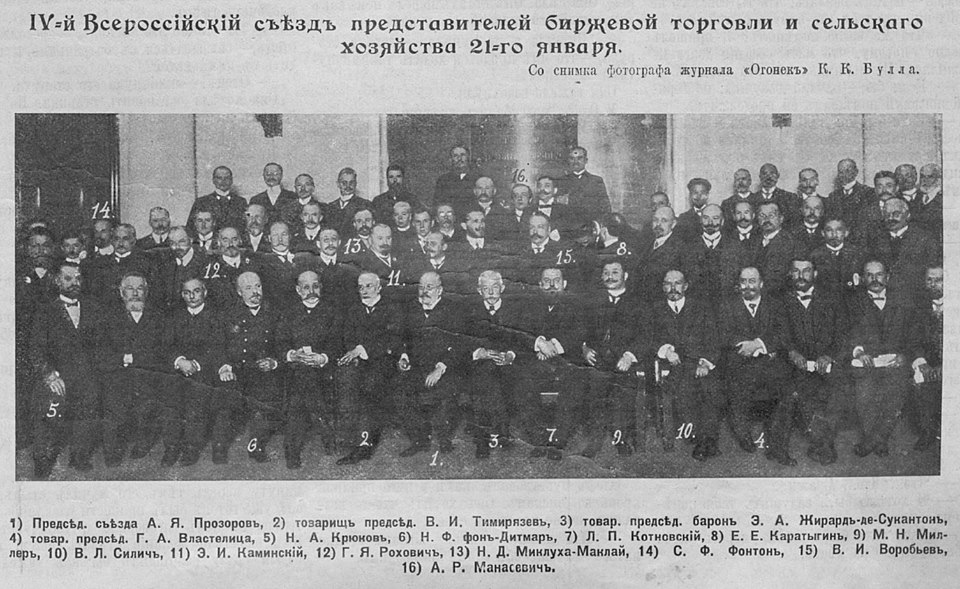
In 1910, N. D. was the founder of the South Russian Society for the Supervision of Steam Boilers; in 1912, he played an active role in establishing the Kharkiv Commercial Institute, and he currently serves as a member of its board of trustees and academic committee. In addition, N. D. serves as: a member of the board of trustees of the Kharkiv Commercial School, a senior member of the Kharkiv Stock Exchange Committee, chairman of the Kharkiv branch of the Russian-Italian Chamber of Commerce, a member of the Council of the Congress of Representatives of Industry and Trade, a member of the Council of the Congress of Representatives of Stock Exchange Trade and Agriculture, an honorary justice of the peace for the city of Kharkiv and the Kharkiv Governorate, and a member of numerous charitable and educational institutions. In 1912, N. D. was elected to the State Council as a representative of industry. In the State Council, N. D. aligned himself with the Center Party. He repeatedly spoke at general meetings of the State Council on issues related to trade, industry, and finance. In the State Council, he is one of the prominent representatives of trade and industry.
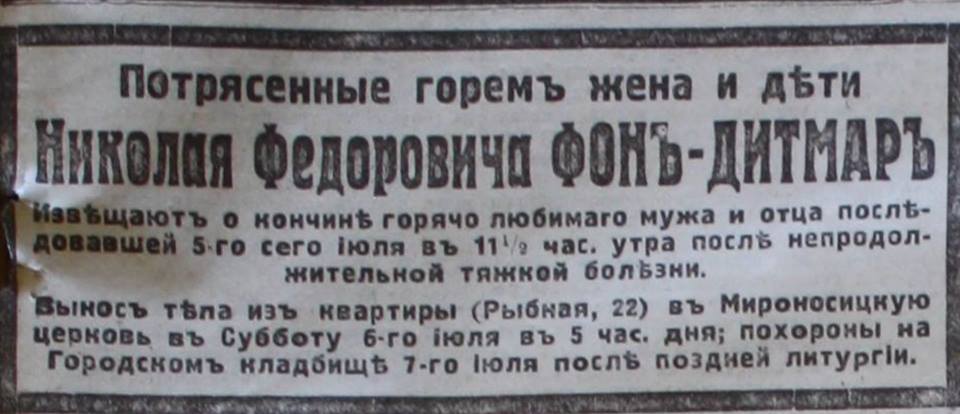
Back in 1919, an issue of the Kharkiv newspaper *Novaya Rossiya* published on July 6 (according to the old calendar) was filled with sad news.
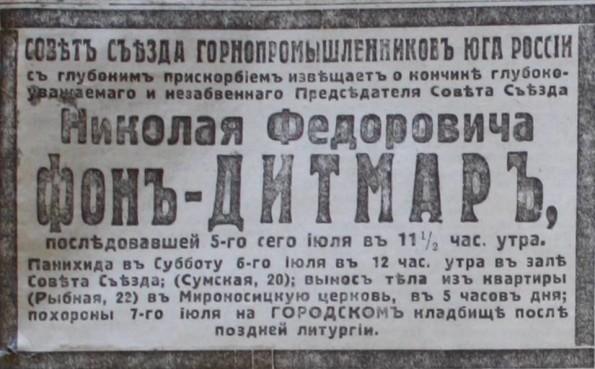
Deeply grieved, the wife and children of Nikolai Fedorovich von Ditmar… announce the passing of their dearly beloved husband and father, which occurred on July 5 at 11:30 a.m. following a brief but serious illness…
Condolences were expressed, in particular, by:
— The Council of the Congress of Mining Industrialists of Southern Russia;
— The Committee of the Kharkiv Coal and Mining-Industrial Exchange;
— The Donetsk Basin Committee for Assistance to the Armed Forces in Southern Russia;
— The Council of the Professional Society of Engineers of the Mining and Metallurgical Industry of Southern Russia;
— The Board of Directors of the Donetsk Mining and Industrial Bank;
— The Council of the Donetsk Mining and Industrial Bank;
— The Board of Directors of the Novosiltsov Coal Joint-Stock Company.
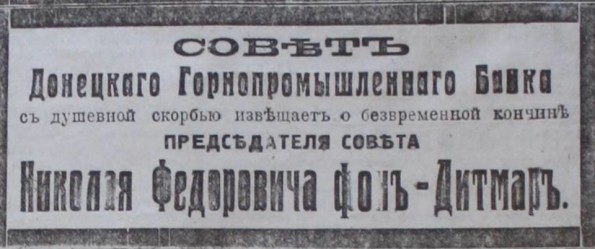
In the obituaries dedicated to Nikolai Fedorovich, the following can be found:
A man has died whose name is known to all educated Russians, and to whose boundless energy and creativity not only our mining-industrial South—whose entire prosperity and development over the past thirty years have been inextricably linked to the name of N.F.—but all of Russia owes a debt of gratitude…
…There was not a single worthwhile endeavor for Russia that was not, to one degree or another, associated with the name of Nikolai Fedorovich. A man of tremendous initiative and exceptional organizational skills, he selflessly and unselfishly shouldered the burden of serving his country’s interests for 30 years. He was the central figure around whom all socially beneficial initiatives coalesced…
…N.F.’s biography is the history of Russia’s entire social development…
Von Ditmar was buried in the cemetery on Hryhoriia Skovorody Street, which was demolished by order of the city authorities in the 1970s. To this day, the exact location of his grave remains unknown.
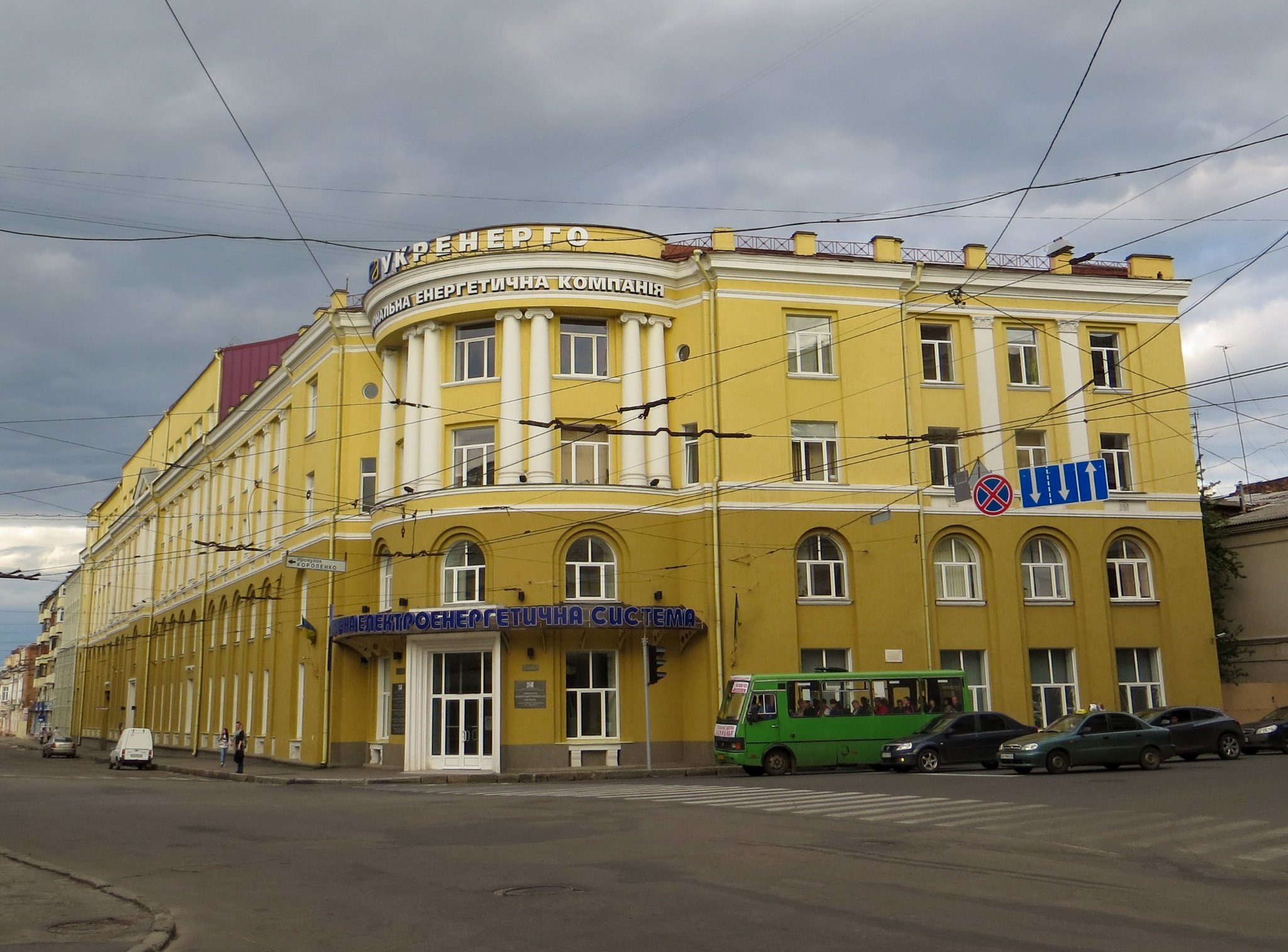
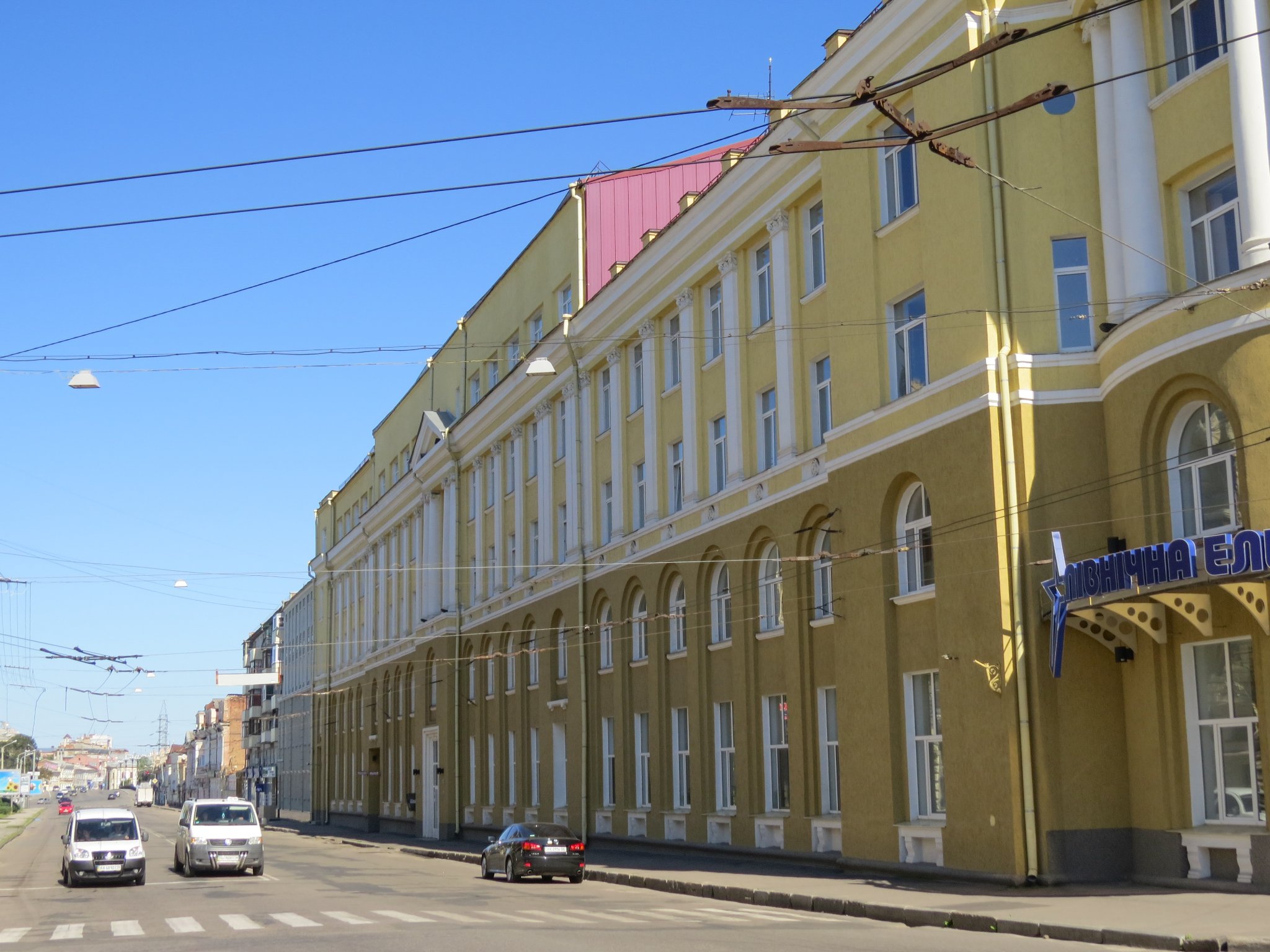
The building of the Council of the Congress of Mining Industrialists of Southern Russia was built in 1902 at Sumska Street, 18/20, based on designs by B. Mikhalovsky and the Zagoskin brothers, with the collaboration of V. Krichevsky.
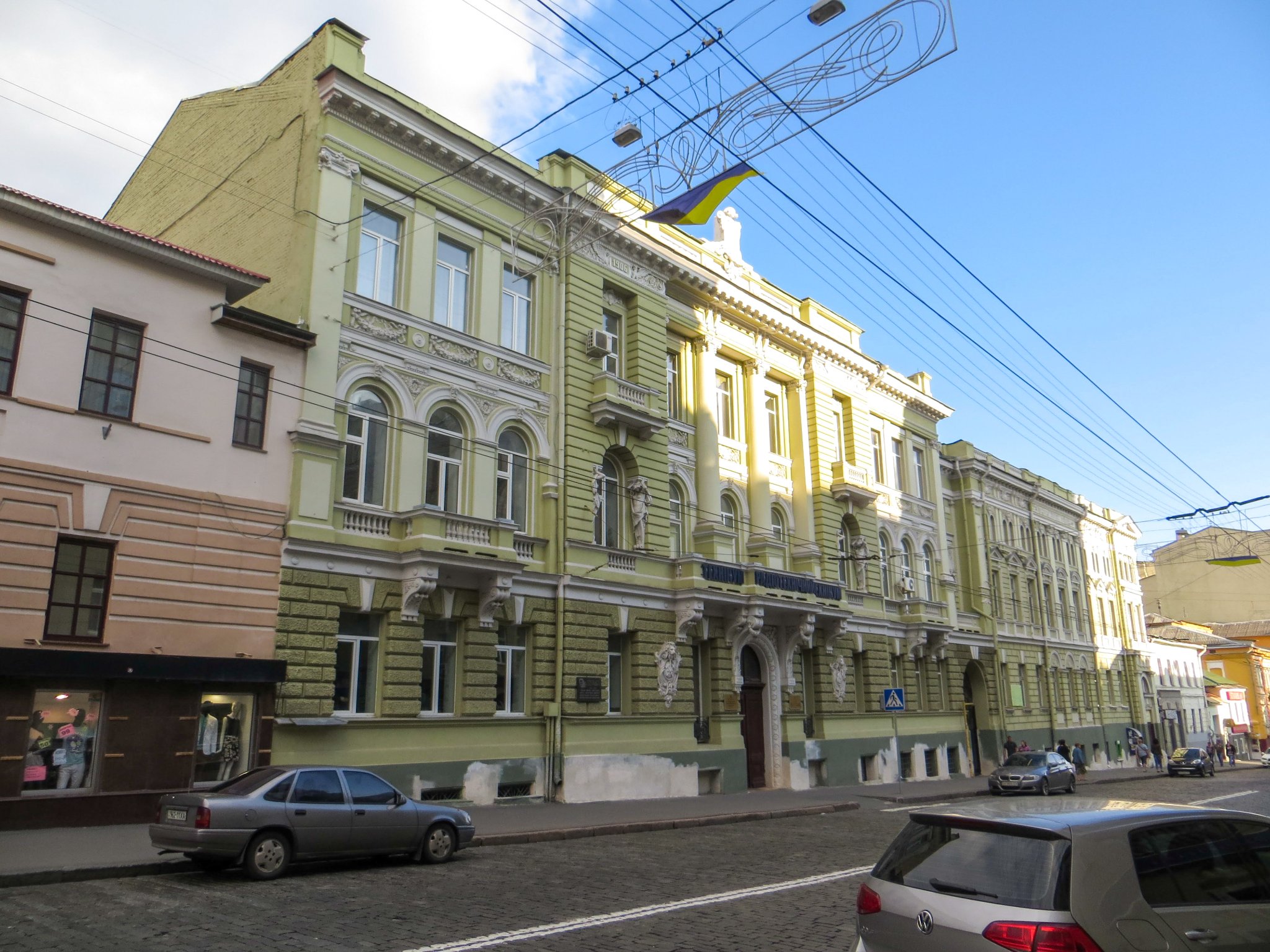
In 1916, the interior was renovated according to a design by O. Beketov. The Council coordinated the activities of many industrial enterprises in Kharkiv and the Donbas. Starting in 1910, the building housed the Aeronautics Department of the Kharkiv branch of the Russian Technical Society. In 1911–1912, it also housed the editorial office of the magazine *Heavier Than Air*, pilot training courses, and an aero club.
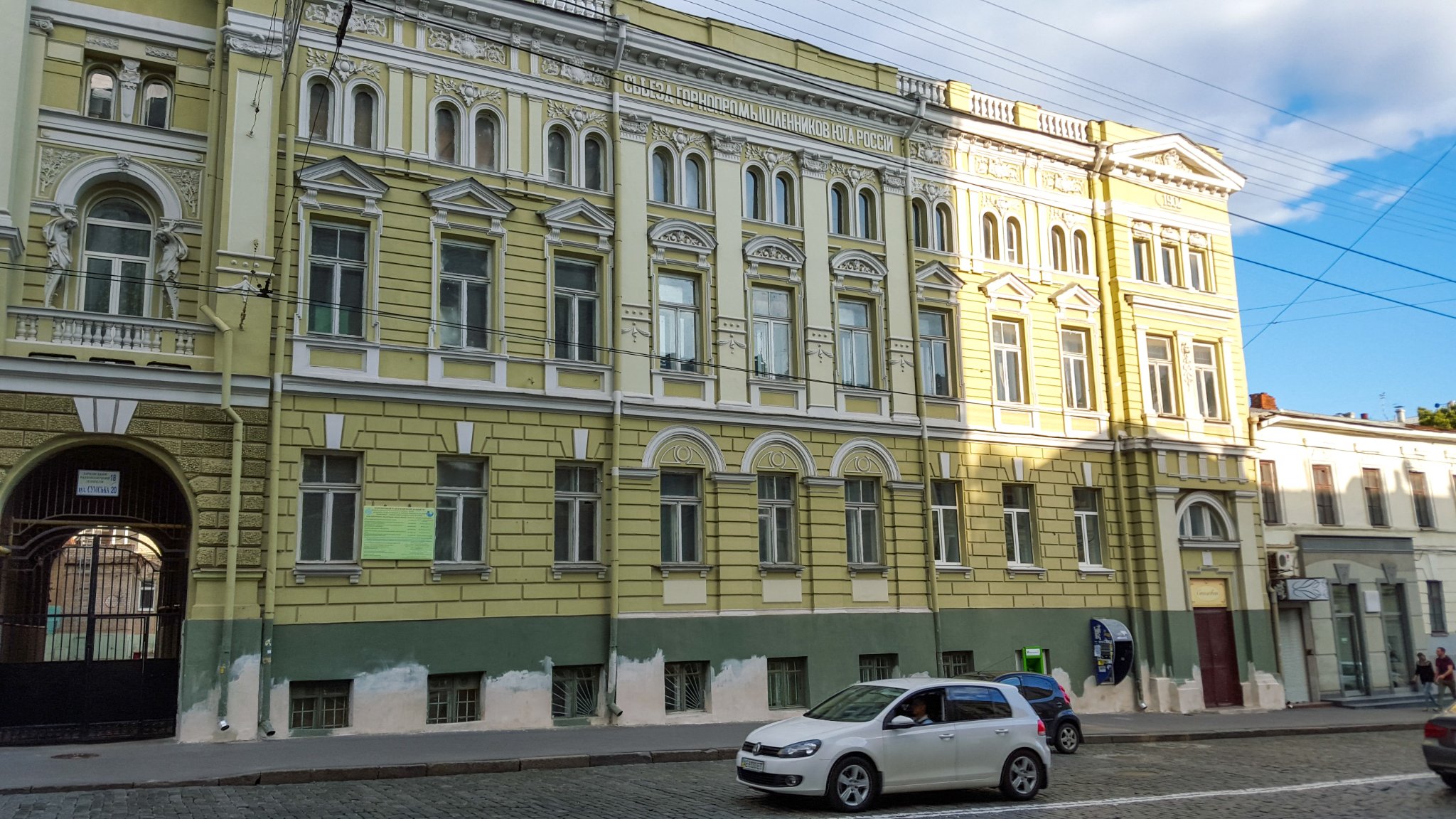
The right side of the building, however, was formerly a house that belonged to the well-known Mrs. Kharina. It was renovated in a style consistent with the main structure. A third floor was added (designed by B. Mikhalovsky).
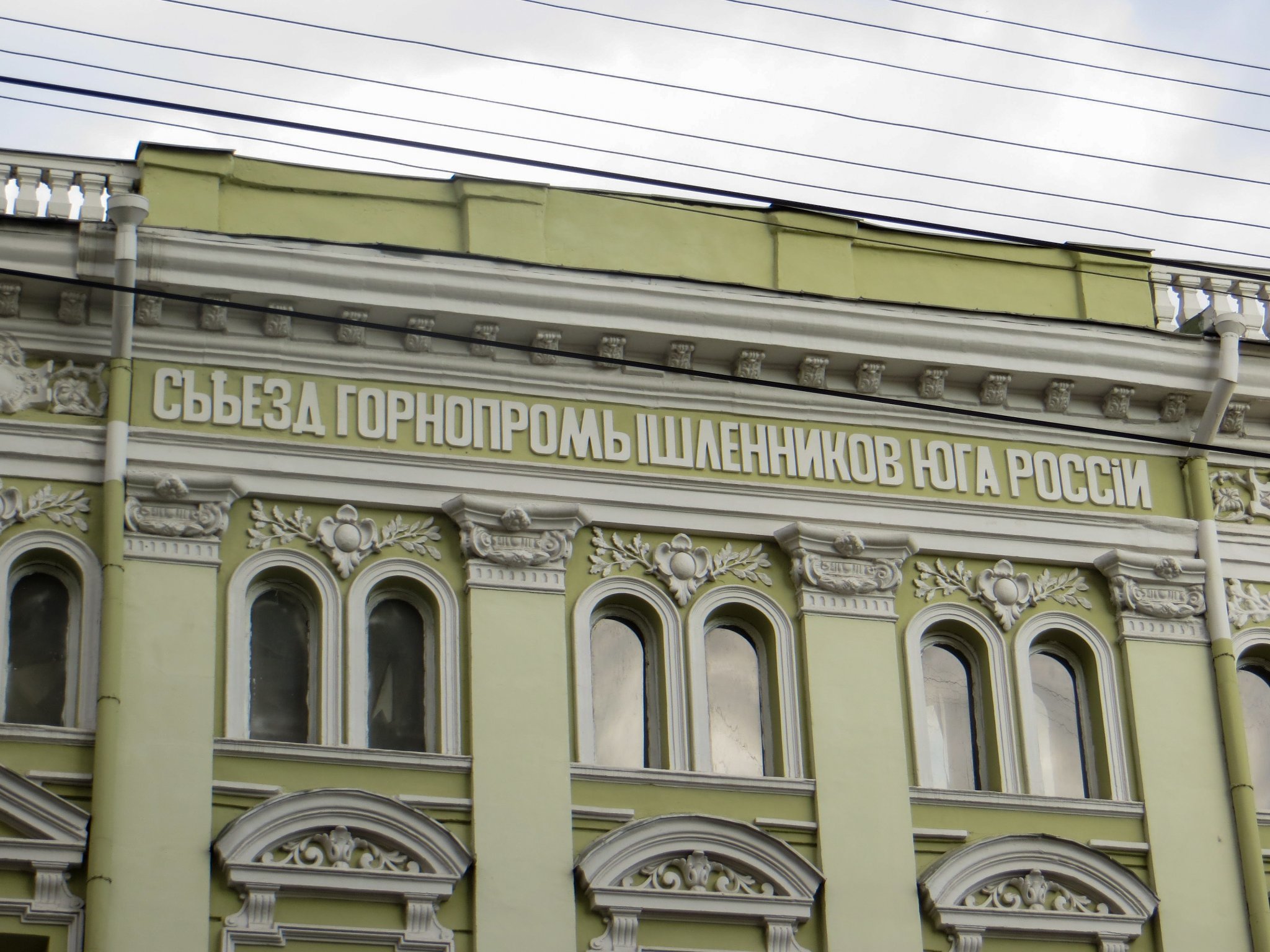
Photo: Ivan Ponomarenko, 2015
According to the 1909 Kharkiv address directory, the property on Gubernatorskaya Street (now Kulykivskyj Descent, 7) belonged to Nikolai von Ditmar. The building itself, as we see it today, was built in 1913. During a recent renovation for the Institute of Fashion and Design, which is now located in the building, the height of the windows was reduced and the shape of the roof was altered. But the striped facade has remained the same.

Another of von Ditmar’s houses, located at Rybnaya Street, 22, was demolished during the construction of the massive Kharkivenergo building in the early 1930s (now Kooperatyvna Street).