The Southern Railway Administration Building can be found right in the middle of Pryvokzal’na Square. It was built in the neoclassical style by architects O. Dmitriev, D. Rakitin, engineers P. Rotttort and V. Glazyrin in 1912-1914.
“Well, the building is standing and standing. It should be, so they built it” – many will think. However, everything is not so simple. The main motivation for the construction of the building was remarkable idiocy, the essence of which is this.

The entire staff of the Central Administration of the Kharkiv Railway, numbering 2,300 people, was housed in 19 rented houses scattered throughout the city at considerable distances from each other. It got to the point of being ridiculous – one department could be located in 3 houses located in different parts of the city. All this, of course, greatly interfered with the coordinated work of the Southern Railway. However, people lived with this and suffered.
However, one day a Miracle suddenly happened! The Southern Railway Administration calculated that 147,000 rubles were spent on renting premises in 19 buildings per year. And with the costs of maintaining city telephones, guards, mail delivery, and paying the city for electricity, the amount was 157,000 rubles per year.
It is clear that such a lot of money was a pity and they decided to build one large building…
Construction of the Southern Railway Administration building in Kharkiv.
The Southern State Railways, formed from the merger of the Kursk-Kharkiv-Sevastopol and Kharkiv-Mykolaiv, serve a wide strip of southern Russia up to a thousand versts (1,066 km) long and up to 400 versts (426 km) wide on average. This richest territory captures both the mining areas of the Donetsk Basin and vast areas of agricultural industry, having a number of large cities and six ports on its lines: Mykolaiv, Kherson, Sevastopol, Feodosia, Kerch and Genichesk.

The Southern Railways, about 3,000 versts (3,200 km) in length, transport up to 1.2 billion poods (19.6 million tons) of cargo and twelve million passengers per year with a cash turnover of 62 million rubles. These roads are serviced by an army of 50 thousand employees, of whom 2,300 people are at the central administration, which is located in Kharkiv.

Until that time, the central administration of the Southern Roads occupied 19 rented houses in Kharkiv, scattered around the city at a distance of 3 versts from each other, which, of course, was associated with significant inconveniences, extremely complicated relations between independent departments, and caused unnecessary expenses for the maintenance of messengers, especially since some departments were forced to be located in several houses distant from each other.

The railroad administration spent more than 147 thousand rubles on renting premises, and when adding the costs of maintaining city telephones, guards, and messengers, as well as an increased fee to the city for electric lighting, the total cost of renting premises exceeded 157 thousand rubles per year. Despite such high costs, private premises did not meet their intended purpose.
Under such conditions, it was undoubtedly profitable to erect its own building, especially since the administration had a suitable land plot at its disposal. The raised issue of allocating the necessary funds received favorable permission, and the road department began work on the construction of its own building this year.
The following norms were adopted as a basis for drawing up the project.
The area of the internal premises, calculated on average at the rate of 11.2 sq. m per 1 employee is distributed as follows:
- about 50% is allocated to office premises, in which several people work, and not less than 5.7 sq. m for each person occupying such premises;
- about 7% for offices, counting up to 22.7 sq. m on average per person;
- about 16% for the council and meeting hall, for common areas (restrooms, tea rooms, library, etc.) and other premises (rooms for couriers, auxiliary archives, storerooms, etc.);
- about 27% for corridors and stairs.
The area of the semi-basement floor, which houses the changing rooms, dining room, central heating appliances, central archive, etc., is not included in the specified area of 11.2 sq. m per person.
The total area of usable space is calculated at 26242 sq. m., except for the mezzanine floor, the area of which is 4683 sq. m.
The building is 5-storey, on a high basement, the layout of the premises is adopted with one-sided light corridors. The height of the rooms on the central floor is 4.26 m, the rest – 3.84 m.
The building is being built near the railway station. The main facade overlooks a large square, currently occupied by a garden that is growing disordered. Finally, the back side faces a narrow alley, on the opposite side of which stands the railway technical school.
Thus, almost square in plan, the building faces all its facades towards the street and the square, which forced to pay special attention to the exterior of the house.

More than 15 million bricks will be needed to complete the wall construction, and the total cost of the work will be 1.5 million rubles, excluding the cost of the rails that go to the foundation slabs and the free transportation of materials.
By the beginning of September of this year, the foundations, a significant part of the high granite base with iron grilles near the basement floor, and part of the brickwork of the walls were laid.
The attached plans do not show a detailed breakdown of the premises, since it will be finally clarified a little later, when the total usable area of the building, which reaches almost three dessiatines (32,775 sq. m.), will be distributed in detail between departments and employees. The two-story hall, which occupies the middle of the third and fourth floors, has a relatively small area, but can be increased thanks to the adjacent reception rooms.
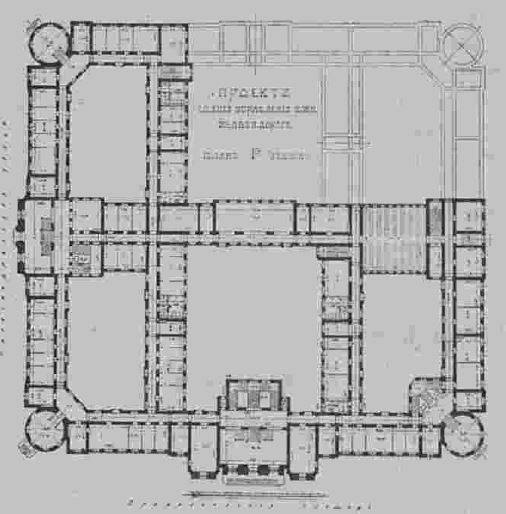
In the basement, the main area is occupied by: the mobilization department, archives, and a locker room for employees. The main railway archive, as can be seen from the plan, is allocated in a special building, clamped by stone firewall walls; it consists of 11 floors like American library and archive storages.
The Engineering Council has made minor changes to the attached plans, with the round corner towers being replaced by a smoother transition. Construction will probably be completed no earlier than the end of 1913 or in 1914.
O. Dmitriev. D. Rakitin.
Source – the magazine “Zodchiy” of 1912.

- Danylevs’koho Street, 19 - 13.10.2026
- Debunking the myth about one of the most famous Kharkiv photos - 12.10.2026
- The Architectural Evolution of the Kharkiv Theater - 26.09.2026