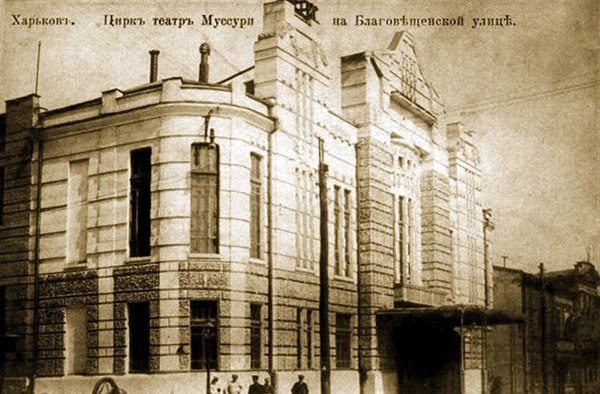
There are probably very few residents of our city who are unaware of the existence of the theater-circus building located at Blagovischenska Street, 28.
People who claim to know the history of Kharkiv come up with all sorts of tall tales about this architectural landmark.
For example:
One of the most mystical and amazing places in the heart of Kharkiv… This is a place where legends are born… theater entrepreneur Gerasim Mikhailovich Mussuri is building a circus. The entrepreneur’s desire to create something great was so strong that the circus not only earned a reputation as the most beautiful circus in Europe, but also became the largest circus in the world.
Or
Architect Kornienko built one of the largest circuses in the world, with a capacity of 6,000 spectators, in 1908. In 1912, the building was converted into an opera house, which came to be known as “Mussuri,” named after the theater impresario Gerasim Mikhailovich Mussuri, who had purchased the building. The circus theater has seen a great deal in its lifetime: performances by Fyodor Shalyapin, Ukraine’s incorporation into the Soviet Union, the adoption of the first constitution of the Ukrainian SSR… For about 60 years, the building housed a musical comedy theater. Unfortunately, the circus theater is now in a state of neglect and is falling into ruin more and more with each passing year. But the city residents’ interest in the legendary Mussuri Circus remains undiminished, and this is likely why the building is shrouded in all sorts of legends and mysterious stories. So, according to one legend, back when the circus was still active, a lion mauled a trainer on stage in front of a stunned audience. Six bullets were fired into the animal, but the woman could not be saved. A second legend claims that the entire theater troupe perished in a fire one day. In general, ever since the theater was abandoned, fires have broken out there regularly. Locals believe the building has this fate because it was supposedly built on a former cemetery and is cursed. But among all these scary legends, there is one more—a very bright one indeed. They say that between the dome and the roof there is a small space, like a room. It is called the “room of wishes.” If two lovers climb into it and make a wish—it will surely come true
Of course, all of this sounds extremely enticing, but the real story is much more interesting. In the article “From the History of Kharkiv Circuses” by Kharkiv researcher A. F. Paramonov, we find the following reliable information:
But in that same year (1892), the City Council granted a long-term lease for a plot of land on Zhandarmskaya Square to the owners of the “Russian Circus,” the Nikitin brothers. Akim Alexandrovich Nikitin built a very comfortable and spacious circus building, with stove heating and a variety of devices for performing the most thrilling acts, including even an underwater pantomime. With the slightest alterations, the circus transformed into a theater. This allowed the Nikitins to change their repertoire more frequently than others, invite up to ten different troupes—both circus and theater—and take them on tour not only in Kharkiv, but also in Nizhny Novgorod, Astrakhan, Baku, Yalta, and Ivanovo-Voznesensk.
Unfortunately, fate was unkind to the Nikitins. In 1908, they were deceived by Gerasim Mussuri, a Greek circus manager, who purchased a plot of land from Count Kapnist at the corner of Dmitrievskaya and Blagoveshchenskaya Streets to build a stone circus for himself, rather than for the Nikitins. In 1909, the Nikitins’ circus gave its final performances, and in early 1910, it was dismantled. As for Mussuri, after building a lavish circus building, he was unable to properly organize tours, and in 1912, the circus was converted into an opera house.

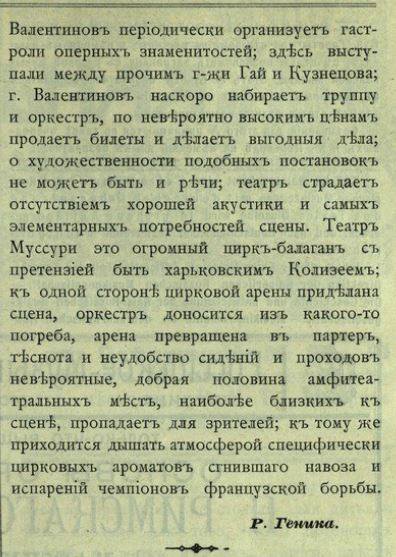
Thus, the stories about the Mussuri Circus contain more fiction than fact. For this reason, documentary evidence from that period is invaluable to us. In one of the leading music publications from 1913, we find a very interesting article by R. Genik. In it, the author refers to the Mussuri Circus as a “tragedy theater” and a “shoddy show.”
The Mussuri Circus Theater is truly a dismal place; there, a certain Mr. Valentinov periodically organizes tours featuring famous opera singers; among others, Ms. Gai and Ms. Kuznetsova have performed there; Mr. Valentinov hastily assembles a troupe and an orchestra, sells tickets at exorbitant prices, and makes a tidy profit; there can be no question of the artistic merit of such productions; the theater suffers from a lack of good acoustics and the most basic stage requirements. The Mussuri Theater is a huge circus-shoddy show with pretensions of being Kharkiv’s Colosseum; a stage is attached to one side of the circus arena, the orchestra sounds as if from some cellar, the arena has been turned into the stalls, the cramped and uncomfortable seating and aisles are unbelievable, a good half of the amphitheater seats closest to the stage are lost to the audience; on top of that, one has to breathe in the atmosphere of the specific circus aromas of rotting manure and the vapors of French wrestling champions.
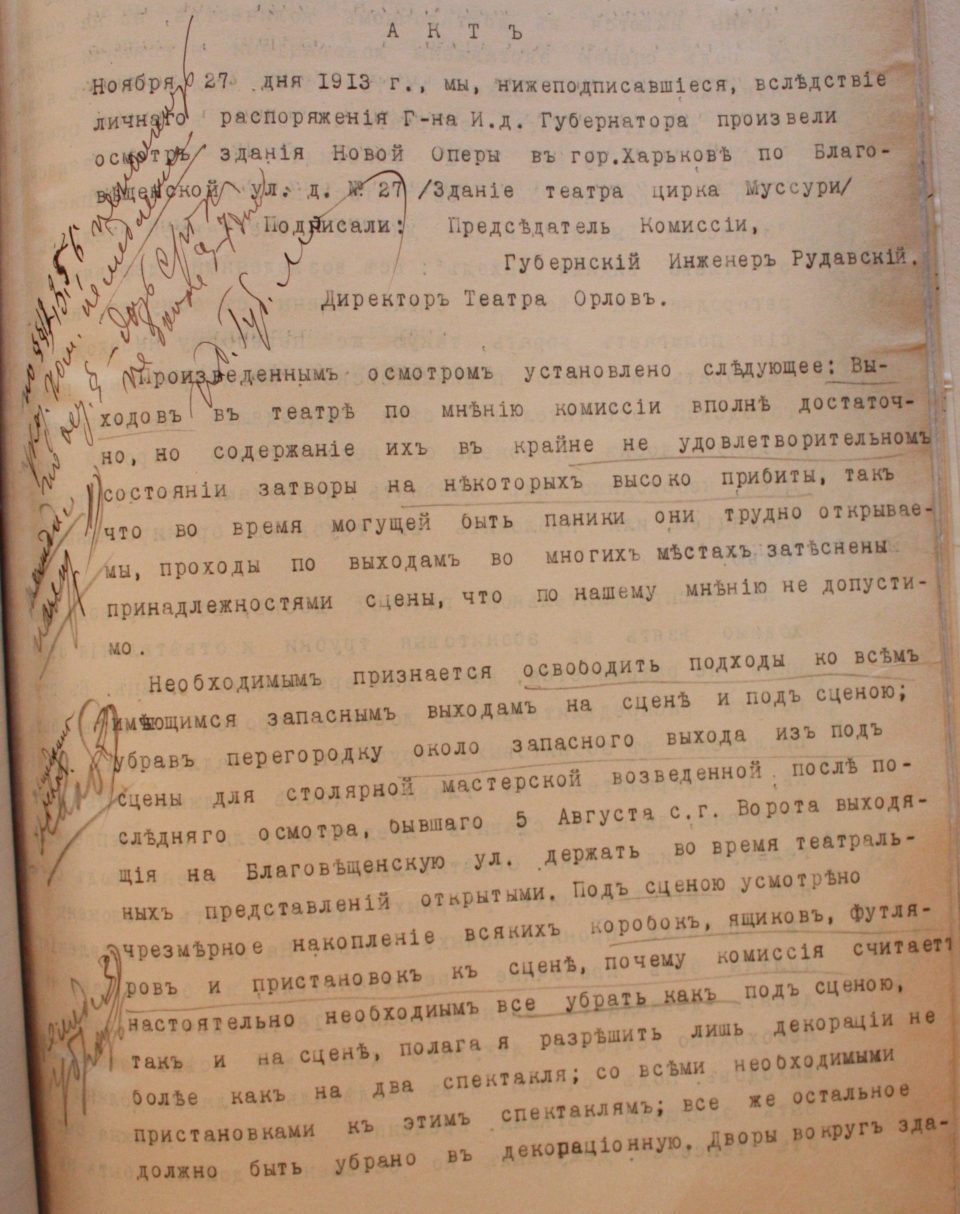
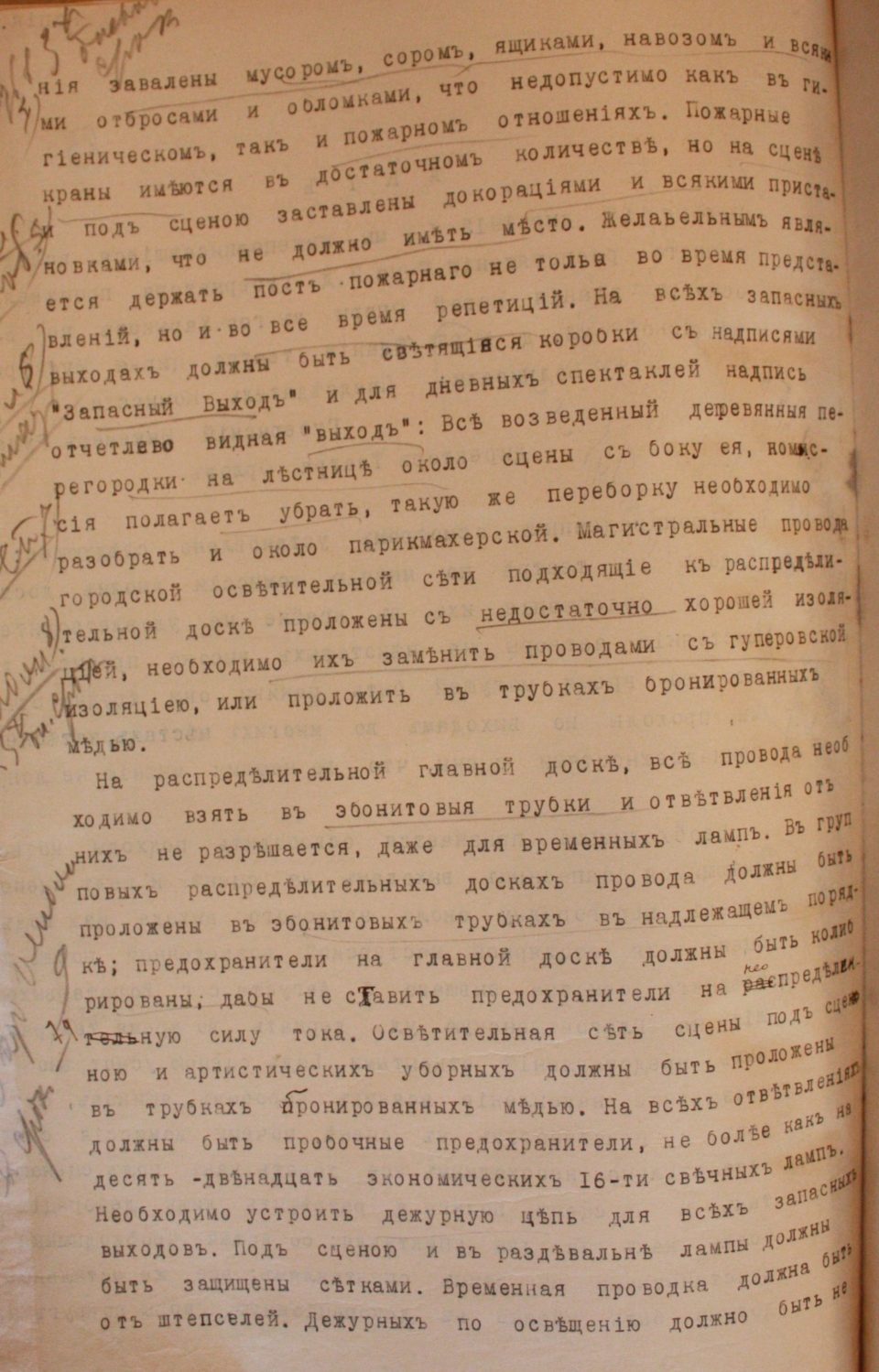
Archival documents regarding the Mussuri Circus are also not exactly full of praise. In files from the early 20th century titled “On the Inspection of All Theaters and Cinemas in the City of Kharkiv,” engineers recorded numerous violations.
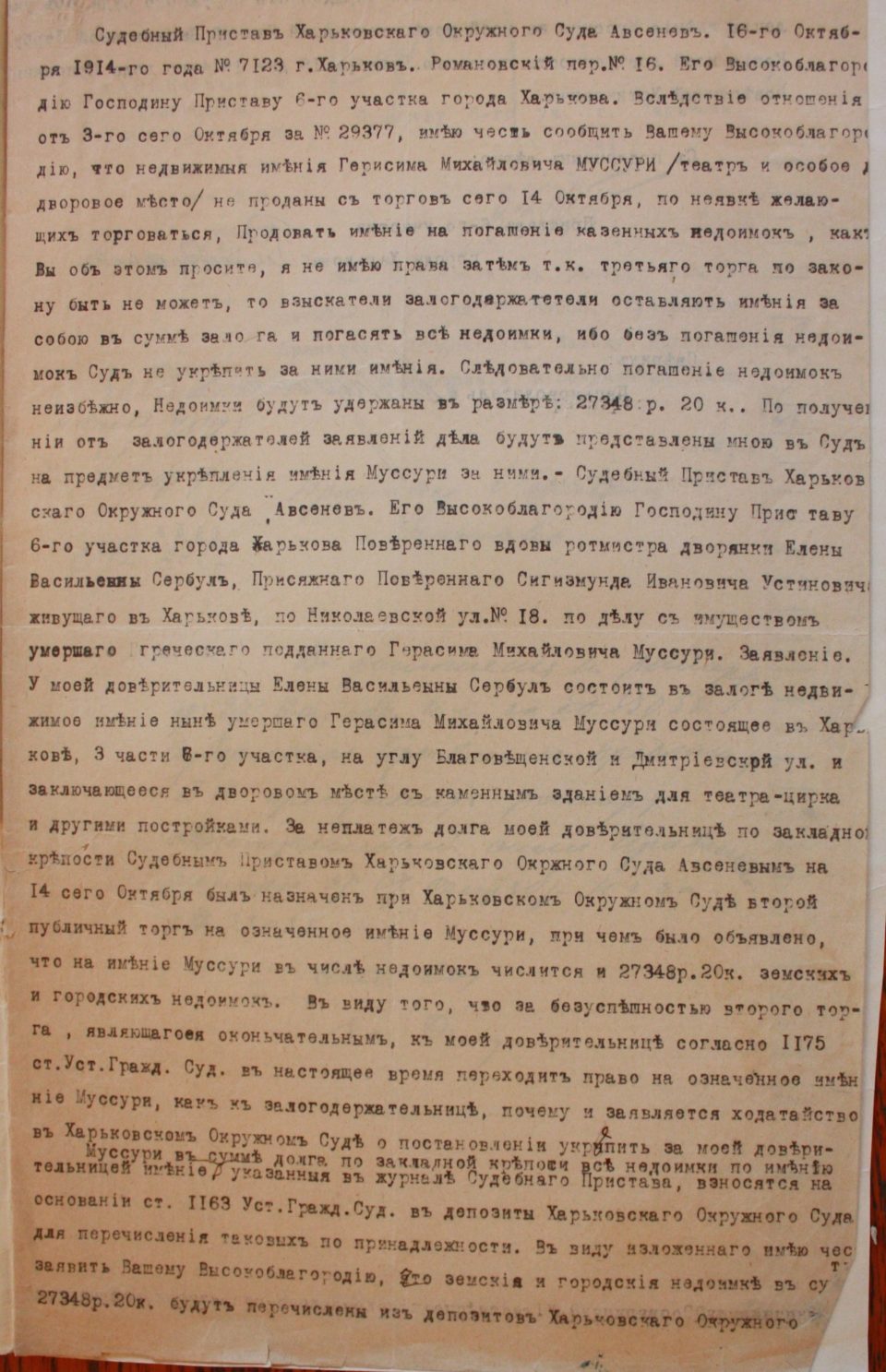
To this day, some people claim that the theater building is supposedly cursed. They say there are plenty of grim stories associated with it, and that it stands on the site of a cemetery. However, I believe the following lies at the heart of all these rumors. In 1914, Gerasim Mikhailovich Mussuri’s real estate holdings (the theater and a specific courtyard lot) were never sold at two auctions. The reason was extremely simple. No one showed up for either the first or the second auction. The theater was heavily in debt, and few people wanted to ruin their relationship with the Nikitins, who had been swindled.
So things weren’t quite so magical and mysterious at Blagovischenska Street, 28. Although, of course, the made-up story about a brilliant entrepreneur obsessed with creating something great is much sweeter than the truth about a con artist and rotting manure…